
The survey comprised responses from 29 Australian trade, education, academic, and professional publishers surveyed in Q4 2025. APA’s goal was to better understand how publishers are addressing sustainability in their organisations, where the industry is making progress, and where more support may be needed.
The survey invited publishers to share their environmental policies, targets and methods of reporting, and the findings are inspiring:
- 62% have a person or team with direct responsibility for their company’s sustainability agenda, up from 56% in 2023.
- 59% have a written environmental policy or statement, up from 56% in 2023.
- 31% are calculating carbon emissions for their Australian operations, up from 19% in 2023.
- 38% are setting carbon emissions targets, up from 15% in 2023.
- 41% use 100% FSC or recycled paper and cardboard for books, up from 33% in 2023.
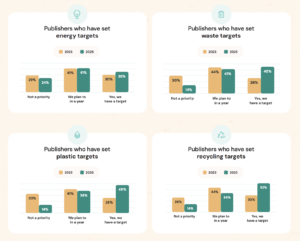
The emissions targets include sustainability targets for energy, waste, plastic, and recycling, as the image below demonstrates:
APA also updated its sustainability recommendations for publishers, including:
- Nominate and appropriately resource a staff member or a team in your organisation to be responsible for sustainability.
- Set up office recycling for paper, glass, soft and hard plastic, metal, batteries and e-waste.
- Commit to 100% FSC or recycled stock for paper and cardboard in book printing.
- Eliminate the use of glitter, and reduce the use of foil and spot varnishes in book printing.
- Only supply printed proof copies and point-of-sale materials to booksellers who have specifically ordered them.
- Set up office composting for food and other organic waste.
UNSW Press CEO Kathy Bail, chair of the Sustainability Working Group, stated: “I’m pleased to see progress in Australia from the 2023 survey, but we’re all in this together globally and can do more. I call on publishers to review our recommendations and consider where they can make improvements in their operations. By the time we run the next survey, it would be great to see an industry that only uses 100% FSC or recycled stock for paper and cardboard in book printing and packaging. As always, we’ll continue to share guidelines and practical initiatives that improve the way we publish books.”
Access the full report here.