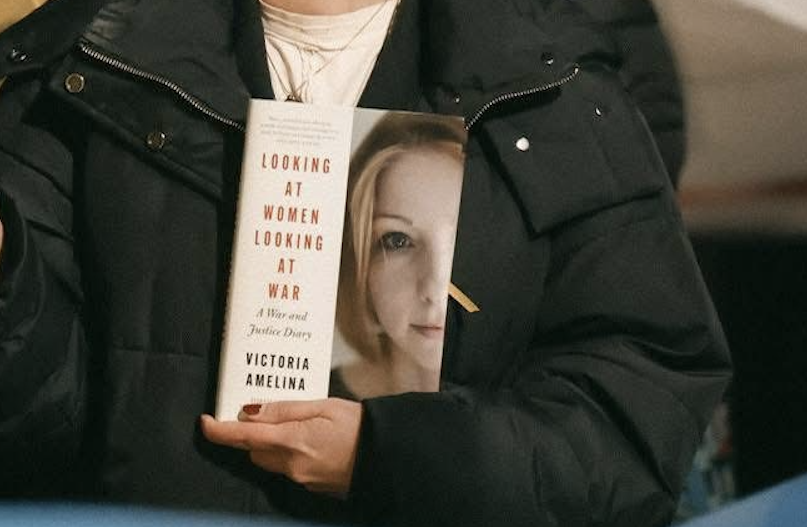
Killed during the Russian bombing of civilians, Victoria’s dedication was recognized in 2024 with the Prix Voltaire Special award of the IPA. The year before, her compatriot Volodymyr Vakulenko received the same posthumous recognition.
A book is not an unusual accessory at protests in my country, Georgia. We have been demonstrating for more than 455 days with many holding books in their hands. Some read; some use them to spread protest messages; and others feel itsignals that this is an intellectual resistance – that a book is the weapon of free people. Filipino Nobel laureate Maria Ressa’s book How to Stand Up to a Dictator, was held by many protestors.
In 2024 IPA also honored Samir Mansour Bookshop for Printing and Publishing with the Prix Voltaire. Destroyed in 2021 and rebuilt, the bookshop once again became a victim of the Israel-Hamas conflict. Yet it continued to bring books to Palestinian youth by visiting evacuation centers. Accepting the 2024 IPA Prix Voltaire, Samir Mansour said: “God willing, we will continue to publish and print, no matter how difficult the circumstances we are living in today. We will continue.”
Last year, I had the honor of presenting the Prix Voltaire myself in Lillehammer, during the World Expression Forum, to exiled Belarusian publishers Dmitri Strotsev of Hochroth Minsk and Nadia Kandrusevich of Koska, recognized for their courage in publishing despite state repression, threats, and forced exile in Poland and Germany.
Recently, while visiting the Cairo International Book Fair, I was delighted to meet Khaled Lotfy, the Egyptian publisher and founder of Tanmia, awarded the 2019 IPA Prix Voltaire. Sentenced to five years in prison in 2019, he was released in November 2022. It was a joy to see him back at work after such a difficult experience – at the book fair, at his own stand, surrounded by books – exactly where courageous publishers like him belong.
This year, as we mark the 20th anniversary of the Prix Voltaire, the recently concluded call for applications suggests that the world has not become better over the past two decades – quite the contrary, we may even have taken a step backward in creating a safe, free, and healthy environment for publishers, booksellers, and writers. Our colleagues in many parts of the world continue their tireless struggle to defend freedom of expression and to secure the possibility of freedom to publish.
This weighed on my heart in early February at the conference “Seen & Heard: Young People’s Voices & Freedom of Expression” in Malta. When Maltese students asked for advice for young people planning to enter the publishing profession, I answered without hesitation: “They must remember that readers expect courage and truth from a publisher.”
Indeed, what gives strength to publishers working under extreme pressure, refusing to abandon their core values, refusing to betray their readers, and striving to preserve truth in an era of mis and dis information and fake news, if not loyalty to truth – loyalty to freedom?
In my first presidential address to our members in 85 countries, I called for unity, because that was my experience in Georgia’s publishing market: whenever our sector faced serious obstacles, we were able to move forward and achieve small victories only through unity and mutual support. And so it continues today.
It was precisely this idea of “fighting side by side” that led to the creation of the new IPA Freedom of Expression Defenders Award. The prize aims to recognize people, companies, organizations, or coalitions that promote freedom of expression, the freedom to publish, and the freedom to read – the trinity of freedoms.
Fortunately, our industry includes organizations that tirelessly promote these freedoms, regardless of whether their own countries face particular threats in this regard. In the 21st century, when one of the sector’s main challenges is self-censorship, I believe that speaking about these issues and planning relevant projects to strengthen this trinity of freedoms is never superfluous. The political climate can change rapidly, shortening the path to censorship. Wherever democratic systems begin to waver, the first to become an inconvenience to a regime are often the defenders of free expression – journalists, writers, publishers, and other representatives of cultural fields.
With this new award, we want to encourage publishers, publishers’ associations, book festivals, and other book-related organizations to reflect once again on their broader mission. If we believe that even a single book can bring about significant change, we must also believe in our own power – and direct that power toward improving the world.
The nominations will not only allow us to gather many of the initiatives undertaken by “people fighting with books” around the world, but will also, we hope, inspire others to borrow ideas and expand such efforts in their own countries. This is how we can create unity. A single step taken anywhere in the world in support of the trinity of freedoms is a spark of hope, a helping hand extended to someone who today needs even greater courage to take that step. Nominations are open until March 31. We eagerly await the first results.
The existence of such awards, which encourage publishers, draw attention to key issues, and give them the sense that their sacrifice is worthwhile, is crucial – not only at the international level but also within local industries. In many places, literary prizes abound, which is certainly important for the development of the sector; yet I would wish to see more awards dedicated specifically to publishers. If grounded in universal values of freedom, such prizes would represent another step forward for each country.
Since being an inaugural jury member three years ago, I have followed Ukraine’s “Chytomo” Prize and seen the remarkable range of initiatives undertaken by Ukrainian publishers and book-related organizations. The prize recognizesoutstanding achievements in Ukrainian book publishing and literary life, particularly their contribution to the social development and restoration of Ukraine, and to make them even more visible. I would also like to take this opportunity to congratulate the recently announced 2025 winners: Sense Bookstore – Book Publishing Market Trendsetter; Yuliya Kozlovets – Ukrainian Book Ambassador; the “Book to the Front” initiative – Book Initiative that Promotes Reading; Osnovy Publishing – Frankfurter Buchmesse Special Award.
It was also a pleasant discovery, during my visit to Cairo, to attend the first ceremony of the Egyptian Publishers Association prizes. Fortunately, such awards exist in other countries as well, and I hope they will take stronger root in more places, because a prize is needed not only for the winner but for the process itself and, ultimately, for the industry as a whole.
Recently, I came across the book White Torture: Interviews with Iranian Women Prisoners by Narges Mohammadi, a prominent Iranian human rights activist, journalist, and the 2023 Nobel Peace Prize laureate. It once again made me reflect on the inequality of our world and on those who were not fortunate enough to be born in a free society and must fight for it at the cost of their own lives.
Narges is currently once again in illegal imprisonment for her civic activism and has been in detention for more than 75 days. She is likely a victim, once again, of the horrific “white torture” about which she and the women in her 2022 book told readers. In the preface, she writes: “This time I was found guilty because of the book you are holding in your hands – White Torture. They accused me of blackening the name of Iran across the world… But nothing will stop me from continuing my struggle against solitary confinement… I will not stop campaigning until human rights and justice prevail in my country.”
And how would her voice have reached us – how would the true, unembellished story of her courageous struggle reach future generations – if not for the publisher who carried Narges Mohammadi’s message from behind prison bars to the entire world?
Today, we live in an era of wars, inequality, and the sharp rise of autocracy
an era that generates both evil and good; that breeds betrayal and fear, but also brings forth courageous and devoted individuals like Victoria,
Samir, Nadia, Dmitri, Khaled, and Narges, who are laying the foundation for a better future. They have already become guardians of truth. The least we can do is to tell their stories boldly.