Michiel Kolman (MK): The term “woke” is often used to criticise diversity, equity and inclusion (DEI) initiatives. How has this label shaped political and public debates around DEI, and what consequences is it having for companies trying to advance LGBTIQ+ inclusion?
Jens Schadendorf: The term “woke” originated in African American activism as a call to remain attentive to systemic injustice. In recent years, however, it has been repurposed in political discourse and is often used to portray progressive social policies as ideological or excessive.
In debates about diversity, equity and inclusion (DEI), the label compresses complex initiatives—such as anti-discrimination training, inclusive hiring practices, or LGBTIQ+ workplace protections—into a politically charged term. This framing can delegitimize these measures by presenting them as activism rather than practical approaches to workplace equality.
The term has intensified polarization, particularly in the United States, where DEI debates intersect with broader culture-war narratives about identity, education, and the role of corporations. Corporate support for LGBTIQ+ inclusion—through Pride campaigns or internal policies—can therefore provoke political backlash, consumer boycotts, or legislative scrutiny.
In Western Europe, the dynamics differ somewhat. Although debates about “woke culture” exist, they play a smaller role in mainstream politics. Stronger legal frameworks on anti-discrimination and workplace equality mean many inclusion measures are more closely connected to regulatory compliance and established social policy.
For companies advancing LGBTIQ+ inclusion, these differences create distinct strategic environments. In the United States, visible commitments may attract both support and criticism. Western European firms generally operate in a less confrontational context. As a result, many organizations frame DEI initiatives in business terms—linking inclusion to talent attraction, innovation, and competitiveness.
MK: Your work focuses on advancing LGBTIQ+ inclusion in the business world and in society more broadly. Why do you see businesses as such a critical arena for progress and are you seeing a shift in prioritization of the DEI agenda?
Businesses play a significant role in advancing LGBTIQ+ inclusion both within organizations and in society. Workplaces are not only economic institutions but also environments where social norms are shaped and opportunities distributed. Because employment determines access to income, security, and career development, company policies strongly influence whether LGBTIQ+ individuals experience dignity, safety, and equal opportunity.
Corporate actors therefore have substantial leverage. Through recruitment practices, promotion pathways, and non-discrimination policies, companies can either reinforce or challenge patterns of exclusion. Many organizations have introduced measures such as equal partner benefits, gender-affirming healthcare coverage, employee resource groups, and inclusive leadership training.
Companies also influence broader economic networks through procurement policies, supply-chain standards, and partnerships with civil-society organizations. In doing so, inclusive norms can spread beyond a single workplace.
Large corporations additionally carry symbolic influence. Through branding, marketing, and public engagement they help shape social discourse and signal which values are legitimate. When major employers support LGBTIQ+ equality, they contribute to the normalization of inclusion.
At the same time, the DEI agenda is evolving. In some regions—particularly the United States—political polarization has prompted companies to adjust how they communicate diversity initiatives. Often this reflects strategic reframing rather than retreat, with organizations emphasizing links between inclusion, innovation, talent attraction, and competitiveness.
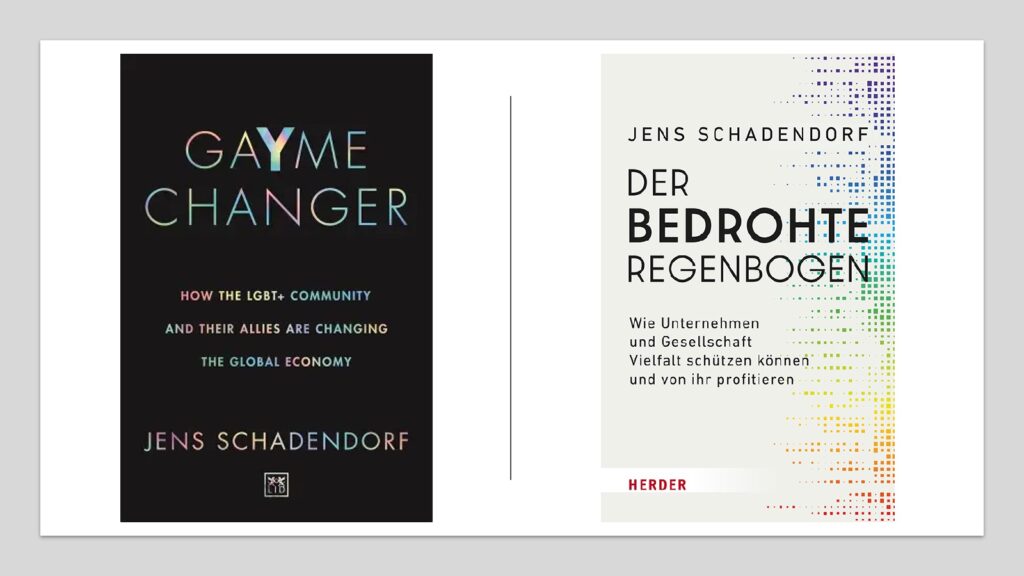
MK: In your last book, “GaYme Changer. How the LGBT+ Community and their Allies are Changing the Global Economy” which was published in four languages and nominated for several awards, you explored leadership and inclusion in the corporate world. What was the core message of the book, and what kind of impact did it have on business thinking and practice?
In GaYme Changer, I examine the economic and societal relevance of LGBTIQ+ inclusion in modern organizations. The central argument is that diversity—particularly the inclusion of queer individuals in workplaces and leadership—is not only a matter of social justice but also a driver of innovation and economic performance.
When people can work openly and authentically, they often contribute more creatively and effectively. Inclusive environments encourage employees to share ideas, challenge assumptions, and collaborate productively.
Through interviews and case studies from different industries and regions, the book illustrates how inclusive workplaces can unlock talent and strengthen organizational performance. It also highlights the emergence of a global ecosystem promoting LGBTIQ+ equality in business, involving companies, advocacy organizations, professional networks, and educational institutions.
By presenting inclusion as a strategic advantage rather than solely an ethical obligation, GaYme Changer helped shift how diversity is discussed in business. It encourages leaders to view inclusion as part of responsible leadership and sustainable corporate development.
MK: Your new book, “The Threatened Rainbow – How Business and Society Can Protect and Harness Diversity” (just released in German, “Der bedrohte Regenbogen. Wie Unternehmen und Gesellschaft Vielfalt schützen können und von ihr profitieren”, with an English version expected next year), examines the growing pushback against DEI and respective LGBTQ+-engagements of companies and other organizations. There are three parts in the book – tell us a bit more about these parts and their key conclusions.
Part I examines the growing backlash against DEI—and against LGBTQ+ rights—in the United States. Although these conflicts have become highly visible in recent years, efforts to roll back DEI commitments and workplace protections did not emerge overnight. Rather, they reflect deeper social and political tensions that have developed over time and are likely to persist beyond the current political moment.
One conclusion is difficult to avoid: the United States has lost its once uncontested leadership in advancing LGBTQ+ inclusion and DEI in business and society. At the same time, attacks on diversity and equal opportunity risk weakening important pillars of the democratic, market-based order that has long shaped the country.
Moving to Part II with a focus on Europe: for Europeans, these developments in the US cannot remain irrelevant. Europe’s economies and societies remain closely connected to the United States. Yet the response emerging across Europe suggests that new momentum may be developing. Across the continent, companies and civil-society organizations connected to the business world have responded with concern to developments in the United States. While uncertainty following the start of the Trump administration has eased somewhat, caution remains—particularly among firms with strong ties to the American market. Part II of the book highlights how corporate engagement with LGBTQ+ inclusion in Europe is evolving along a somewhat different trajectory. New initiatives are emerging across companies, professional networks, and non-profit organizations, supported by committed individuals and institutions.
Examples can be found across Western, Southern, Central, and Eastern Europe, involving companies such as Audi, Beiersdorf, BNP Paribas, Deutsche Bank, Henkel, Ikea, ING, MSD, Otto, PwC, Sandoz, Raiffeisenbank International, and Vienna Insurance Group.
Civil-society organizations also play an important role, including Germany’s Prout at Work Foundation, the Dutch Workplace Pride Foundation, the Swiss LGBTI Label, Vienna-based platforms such as Pride Biz Austria and East Meets West, and the growing European Pride Business Network which is supported by the European Union.
Together, these actors form an ecosystem shaping a distinctly European approach to cooperation between business and the LGBTIQ+ community—one that combines social responsibility with economic pragmatism. Similar approaches are also emerging in parts of Asia, including the Philippines and India, while counter-movements supporting inclusion can also be observed within the United States.
In summary, although backlash against the queer community is occurring in many parts of the world and the corporate LGBTIQ+ landscape remains challenging, several developments—particularly in Europe and, to some extent, in other regions—provide reasons for hope.That is an important message of my book.
The third and final section outlines a brief “guide to smart action,” drawing on the analyses and examples presented earlier.Seven recommendations highlight what companies, non-profit organizations, and other key actors should consider if the opportunities created by diversity are to be fully realized.
In times of political and social change, these decisions matter greatly. They influence not only the success of companies and civil society but also the foundations of a modern democratic market economy—resilience, creativity, productivity, dignity, respect, and equal opportunity.
MK: If we’re talking ‘main character energy’, should the next big Netflix series or bestseller center on a queer CEO running the show—and how could that kind of representation shift perceptions of LGTQ+ leadership in business and society?
Representation in storytelling expands what audiences imagine possible. A major series or novel centered on a queer CEO would therefore have significance beyond entertainment.
Queer characters in mainstream media have often appeared as supporting figures. Placing a queer executive at the center of the narrative reframes that dynamic: identity remains present but exists alongside ambition, strategy, vulnerability, and leadership.
Such portrayals can gradually challenge stereotypes about who looks like a leader. When audiences repeatedly see capable LGBTQ+ executives in positions of authority, leadership becomes associated with a broader spectrum of identities.
Stories also provide role models. For young professionals who rarely see themselves reflected in positions of power, a charismatic queer CEO can signal that authenticity and leadership are compatible. In this way, the story would not simply depict leadership differently—it would expand our collective imagination of who can lead.