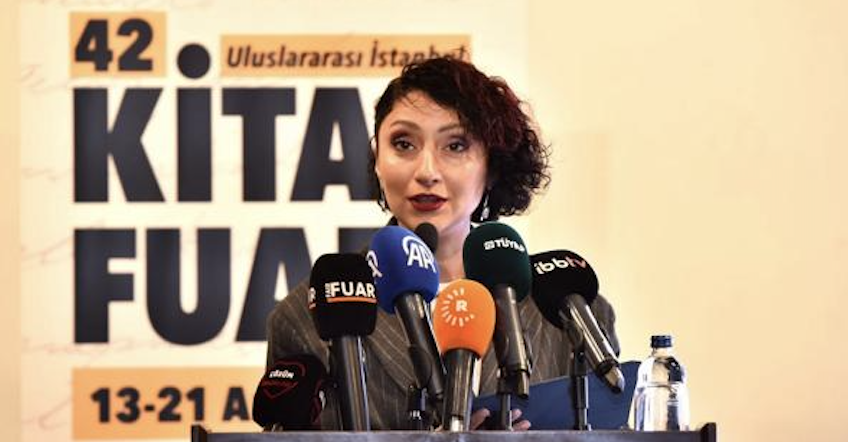
Speaking on the significance of the freedom to publish, Jobava traced its origins back to the early days of publishing, when brave publishers challenged dominant political and social powers. Reflecting on the evolution of the Freedom to Publish Prize into the Prix Voltaire, Jobava honoured past laureates, including Ragip Zarakolu, Evrensel and Turhan Günay, but also publishers from Vietnam, Belarus, Egypt, Lebanon, Hong Kong, and Thailand. She noted that many of them have faced intimidation, harassment, imprisonment or worse. Yet, they persist in publishing works that question authority, keeping that tradition alive of publishing works that challenge our societies.
Alongside freedom to publish, Jobava highlighted the relevance of copyright as a vital daily instrument to secure rights related to books, translations, and film or theatre adaptations. She said: Governments and technology companies know how important we are. They ban our books, they steal our works to train their machines. They nationalise educational textbook publishing; they have just done it in my own country, Georgia.
Calling attention to the Georgian scenario, Jobana said that, since 2013, Georgian publishers have fought to protect the free market for school textbooks, believing that diversity in educational materials is essential to raising a new generation of critical thinkers. However, she lamented that in countries where the government is attempting to establish an autocratic regime, fostering citizens is not a priority.
She concluded by calling on members of the IPA to strengthen their cooperation, pooling shared experience, information, and networks to defend and advance the freedom to publish worldwide.
Image credits: Istanbul International Book Fair