
Last month saw the publication of the latest PISA report, containing the 2025 results, including those for reading comprehension, which show a widespread decline in scores across most participating countries.
I do not think it is too much of an exaggeration to argue that we are living through an axial moment for the future of humanity and the role of digital tools. I am referring to the very hierarchy that will eventually be established between human beings and the means of automation and statistically based tools that are generative in nature and, much more significantly, agentic.
Over the past few days, I have been thinking about the kind of argument I have a duty to make in this space that the IPA has kindly given me to reflect on literacy. It is likely that many of us working in this field will need to devote more effort to understanding the underlying currents of this challenge and the convergence of the many variables involved.
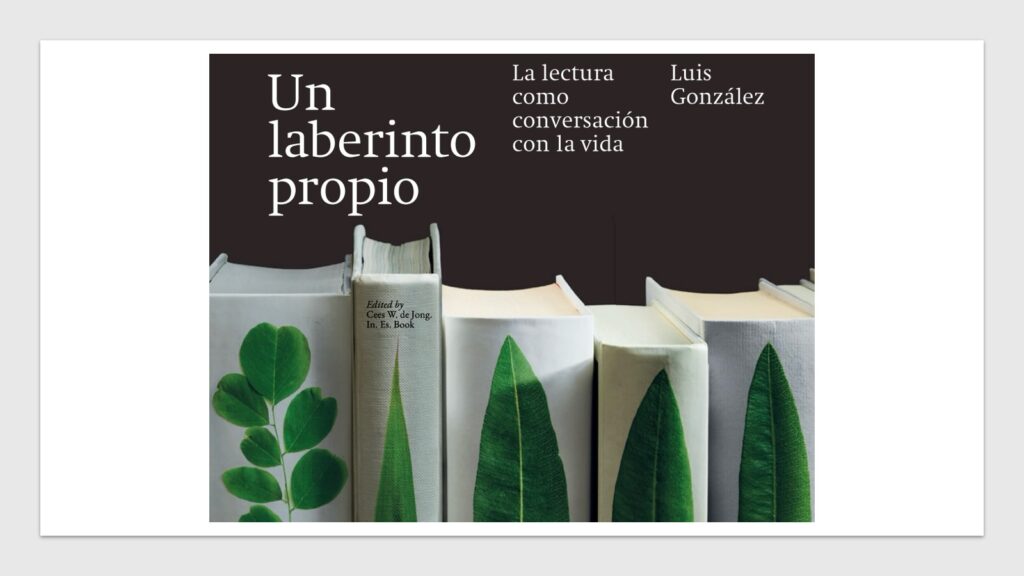
Today I am going to take the considerable liberty of reproducing an extract from a book I wrote a year ago and which will be published in Spanish next month: Un laberinto propio (A Labyrinth of One’s Own). Since this is a blog, I think there should occasionally be room for personal experience and for sharing lessons that can stay with us throughout our lives. In this case, memories of a discovery come together with a reconciliation with effort and learning, and with the connection between the challenges of the present moment and intelligent responses to them.
The passage, which I have translated into English, reads as follows:
«Another reason for my ‘Italophilia’ is that, when my parents sent me to Hastings at the age of fourteen to improve my English, I returned with the beginnings of a knowledge of Italian, because that summer I fell in love with a girl from Treviso.
In the autumn, shortly after those summer encounters -in the corridors of the school for foreign students or on the beach, with its pier reminiscent of the famous one in Brighton- our literature teacher in Madrid came into the classroom one day and wrote some lines of verse on the blackboard. His manner of speaking was pompous and affected; his clothes were extravagant: white suits with black stripes, or the reverse, a handkerchief in his breast pocket, striking hats and two-tone shoes.
I remember one of my classmates laughing at him incessantly -or did we all do it? The girls, by contrast, did not join in. It now seems obvious to me that they were much more intelligent. That day, however, this teacher left me astonished. He first wrote a sonnet from Dante’s Vita nuova on the board in Spanish and then copied two passages in Italian (“A ciascun’alma presa e gentil core…”). He underlined words, drew lines between the two versions and explained the meaning of each term in the context of Dante’s love for Beatrice.
It was an epiphany: I was like that adolescent who crossed paths with a girl in the streets of Florence without daring to speak to her, yet felt an inexplicable devotion towards her. I was that boy unable to sleep as he remembered the look she had given him when she said hello on the platform at the railway station during our excursion to Rye, while her friends laughed and whispered something in Italian.
That part of the greeting -which happens to Dante several years later- appears in one of the narrative passages in the third section of the Vita nuova, when Beatrice Portinari looks at Dante and his life changes for ever. Our teacher read us the passage: ‘And as she passed along a street, she turned her eyes towards where I stood in fear … and greeted me with such virtue that I seemed then to see the utmost bounds of blessedness.’
That teacher was a genius. I have been fortunate enough to have had several teachers who changed my life. And this one, besides explaining the general meaning of the work, taught us about the musical beauty of its poetic construction: how the first line of each tercet rhymes with the third, and how the second connects with the first and third lines of the following tercet.
Just as Dante wrote, “And when I saw her, I felt her to be so unlike all other women…”, I was astonished by the power of that writing. When journalists ask me how we can encourage young people to read, I tend to repeat the same idea: literature must be meaningful to them, because they recognise themselves in it, because they encounter a character, a situation or a question that is also their own. In other words, it helps if they can ask themselves: “What is there of Dante in me?”.
This connects with another debate: what kind of reading should we encourage? Because I work professionally in this field, I am aware that arguing for the need to promote “ambitious reading” -demanding reading- can arouse a certain degree of suspicion.
In our society, departing from orthodoxy is becoming increasingly risky, and in Spain that orthodoxy dictates that reading must be extended throughout society, something with which I agree wholeheartedly; how could I not, when this is precisely what I have devoted my professional life to? But many of the priests of this particular “church” also maintain that inclusion requires us to relinquish excellence. That is where I disagree.
I believe that guaranteeing literacy and access to high-quality books is perfectly compatible with advocating a form of reading that involves complexity, immersion and sustained commitment over long periods of time. It is not merely compatible; it is more coherent.
This is not about returning to an education restricted to a privileged few, as was the case in Florence in the period following Dante’s childhood. I am not referring to the situation Alessandro Barbero describes when quoting Giovanni Villani: “Between eight and ten thousand boys and girls were learning to read; between one thousand and twelve hundred ‘garzoni’ were learning arithmetic; and between five hundred and fifty and six hundred were studying Latin and logic”.
To advocate ambitious reading -as the Ljubljana Manifesto proposes- is not elitist. Quite the opposite: abandoning that goal weakens reading skills, creativity, cognitive health and our capacity for democratic debate. »
I hope that the IPA will play an increasingly prominent role in arguing that education systems must make the development of literacy skills a priority. The PISA results should be treated as a wake-up call. It is time to make use of this evidence and develop a coherent programme of action in response.
With every passing day, I find myself more determined to defend ambitious reading as an educational objective that should be guaranteed equitably to every member of the new generation.
I have always found publishers to be among those who insist most strongly on the crucial importance of promoting reading. This is not simply because cultivating readers is essential to ensuring demand for books and the sustainability of the publishing industry. It is also because, by working with books and readers every day, publishers understand particularly clearly that a citizenry equipped with advanced reading skills is a strategic asset for any society that wishes to live in freedom and sustain democratic coexistence.