
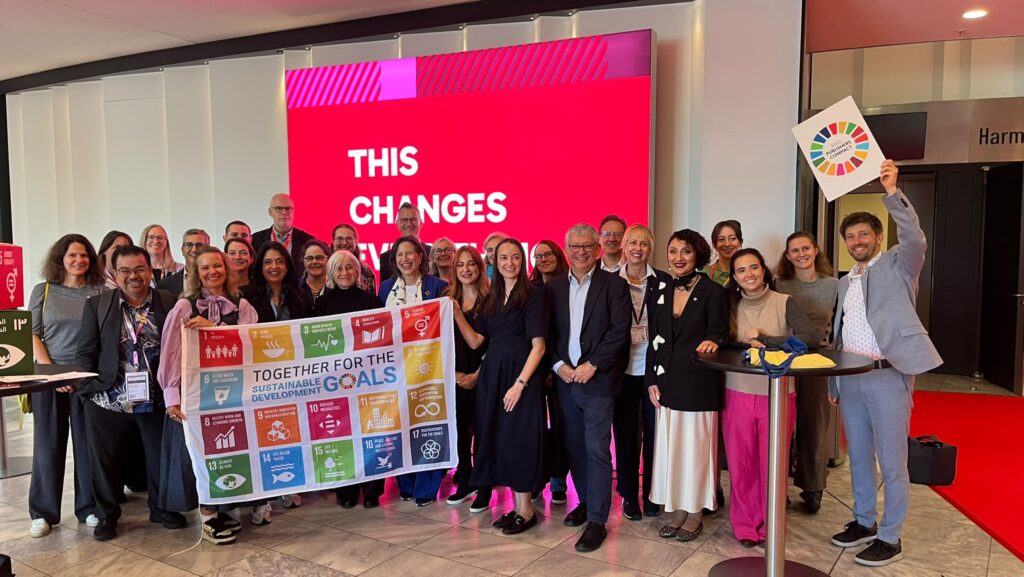
An urgent issue, a shrinking spotlight
During the pandemic, the sector’s carbon footprint was firmly in the spotlight. Everyone was asking: are we sustainable? How bad are books for the environment?
By 2026, AI has taken over the conversation, and we heard far more “we took the plane” than “let’s try the train.” The moral case for climate action is no longer enough to change behaviour. The case has to be a business and economic one: lower costs, reduced risk, and meeting the expectations of regulators, partners, and readers.
On our panel at the fair tackled the subject head-on. Moderated by UN Under-Secretary-General for Global Communications Melissa Fleming, it brought together IPA executive Committee member Christie Henry of Princeton University Press, ZDF meteorologist Özden Terli, and Darya Sotoodeh of Fridays for Future.
Fleming set the scene with a stark contrast. The last eleven years were the warmest on record, yet global media coverage of climate has fallen by nearly 40% since 2021. Climate desks are closing, while disinformation, much of it backed by fossil fuel interests, fills the gap.
Terli described the effect firsthand. During this summer’s record European heatwave, he faced a steady stream of claims that such temperatures were normal. His message was blunt: we now live in a different atmosphere, producing different weather, and some consequences are already locked in.
Sotoodeh challenged the dominant framing: climate change is not a distant apocalypse but a present reality, and adapting to it is a chance to build better ways of living.
Climate is a security question
The wider Frankfurt programme made the same link. In the fair’s “Frankfurt Calling” strand, former Economy Minister Robert Habeck was billed to analyse the connection between climate change and security policy. His new book, Arctic Meltdown, puts the Arctic at the centre and shows how climate change and great-power rivalry are reshaping the global order. Human rights lawyer Philippe Sands also examined the consequences of ecocide, the large-scale destruction of ecosystems.
The point for publishers is that climate is no longer a niche “green” subject. It sits under migration, energy, defence, trade, democracy, and, increasingly, regulation. A list that covers any of those topics is already a climate list, whether or not it says so.
Henry turned to the knowledge base itself. Research funding is under strain on several fronts, from the dismantling of the U.S. EPA’s Office of Research and Development in 2025 to significant cuts at the National Science Foundation and a reported £100 million reduction to the UK’s Biodiverse Landscape Fund. For scholarly and academic publishers, this is not abstract. Fewer funded studies today means fewer evidence-based books tomorrow.
Talking about climate is only useful if we also act at home. Two practical tools discussed at the fair stood out.
- The GBA Book Carbon Calculator. The Green Book Alliance (GBA), jointly led by Book Industry Communication (BIC), the Book Industry Study Group (BISG), and BookNet Canada, launched its free Book Carbon Calculator in June 2026 and held a pre-Frankfurt workshop. The tool lets publishers and their supply chain partners estimate the carbon footprint of an individual printed book, either to inform decisions before a print run or to record the impact afterwards for reporting.
- SNE’s Responsible Chapters: At our annual sustainability summit, we heard from our French member SNE about progress on its eco-responsibility initiative “responsible chapters” launched back in 2025. The project is built around three core pillars that include a practical tool for calculating carbon impact called Livrempreinte (https://www.livrempreinte.fr/), free e-learning training for anyone who works in a publishing house and wants to learn about the book’s ecological impact and a life cycle assessment.
What does this all mean for publishers?
Three takeaways stood out:
- Keep climate on the list. Tell climate stories across genres, in ways that are compelling as well as important. You can make this commitment visible by signing up to the SDG Publishers Compact.
- Match the pace of disinformation. Evidence-based publishing needs to keep up with, or outpace, the falsehoods in circulation.
- Act at home too. Measuring and reducing our own emissions gives us credibility when we publish on the subject. Eco-design and green choices also contribute to saving costs.
At the IPA, we believe publishers hold a unique position in the information ecosystem: we invest in authors, verify claims, and give ideas room to develop. As newsrooms retreat and funding tightens, that role matters more. The climate crisis hasn’t gone away. It has become easier to overlook, and publishers are well placed to make sure it isn’t.
For more check out the IPA SDG dashboard here and tell us what climate actions you are working on as part of our 1000 actions campaign.
Sign the SDG Publishers Compact here.