
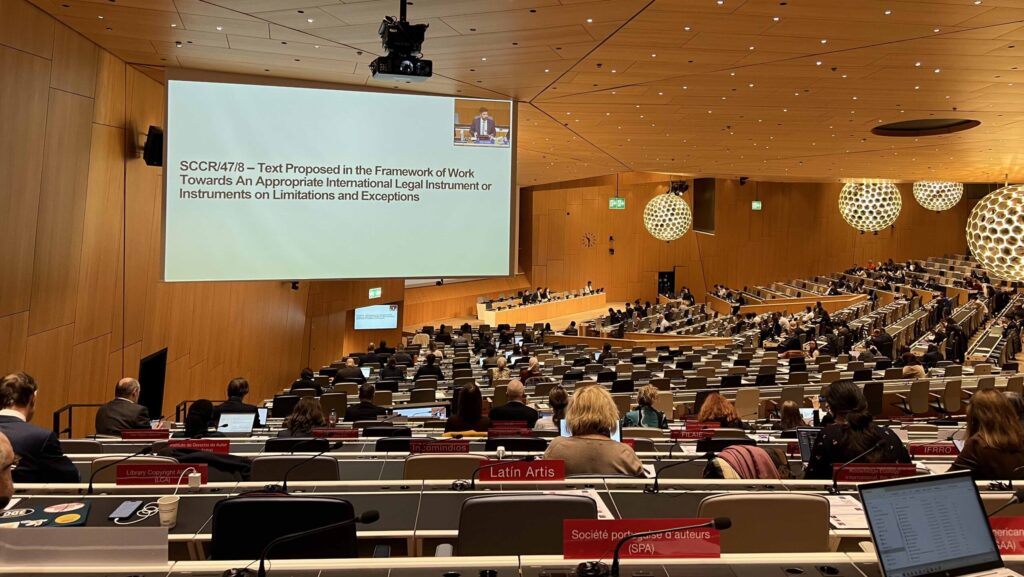
SCCR Chair, Vanessa Cohen, was unable to join today as she was unwell. Many Member States wished her a speedy recovery (and we do, too). That meant that Vice Chair, Peter Labody started the day with a presentation on the Text Proposed in the Framework of Work Towards an Appropriate International Legal Instrument or Instruments on Limitations and Exceptions (SCCR/47/8) followed by brief presentations from the African Group on their Proposal on Limitations and Exceptions (SCCR/47/5) and the USA which presented updated versions of the document and principles for exceptions and limitations for libraries and archives(originally SCCR 26 /8, then SCCR 44 /5), and objectives and principles for exceptions and limitations for educational, teaching and research institutions (originally SCCR /27 /8). Both documents were published yesterday as SCCR 47/9 and SCCR 47/10.
In the afternoon, the side event Rethinking Author Rights in the Second-Hand Book Market, organised by the International Authors Forum (IAF) and La Sofia took place. Kevin Fitzgerald (IAF) moderated the discussion featuring Barbara Hayes (ALCS, UK), Florence-Marie Piriou, Geoffroy Pelletier (both La Sofia, France), and Jewel Greene (Trinidad and Tobago Writers Guild President). The session presented findings from a survey carried out by La Sofia in France on the fast expansion of the second-hand book market and its impact on original creators and their potential revenues, estimated at 16m EUR. The study examined the market’s growth, the profile and motivations of buyers, and found an increase in the development of the second-hand book market as a primary source for consumers, which unfortunately does not translate in increased revenue for authors, illustrators, publishers or other creators.
Back in plenary, the Vice Chair reported briefly on the constructive informal discussions, noting that efforts would continue to identify areas of agreement for progress.
The Vice-Chair then shifted to the secretariat presentation of the Access toolkit, initially scheduled for Thursday. The secretariat reported on the work so far and confirmed that a draft toolkit would be made available before the end of December with a deadline for comments by end of February. A revised text would then be presented at SCCR 48 in May 2026.
And with that, surprisingly, the Vice-Chair closed the Limitations and Exceptions Agenda items with no further comments from Groups or Member States. IPA submitted the following statement with regard to this agenda item:
The following statement has been endorsed by our member and WIPO observer the African Publishers Network (APNET).
We thank those Member States who have stated clearly that the provisions and exceptions in the current instruments are sufficient. This view is shared by our 107 members from 85 countries.
In Africa between 70 and 95% of all publishing is education publishing. These are African owned companies supporting African authors, and they curate and produce materials that are specific to African students.
Our members tell us that they have not been consulted by their governments and are surprised and concerned about the proposals here.
Copyright is the mechanism that enables this industry. To weaken copyright by broadening exceptions and imposing a global treaty would risk destroying the African book sector and any prospects of self-sufficiency. It would shift value away from the African continent and into the pockets of the biggest corporations that have ever existed.
Rather than this massive appropriation of African wealth and innovation, we ask instead that Members States support their indigenous creative industries by enhancing the exclusive rights of creators and publishers, by focusing on enforcement and by eliminating piracy.
Discussions switched to Agenda item 8, Other Matters, and opened with the Artist Resale Right, with a video presentation of the African Regional Conference on Resale Right held in Rabat in October 2025 and a further report by the delegate from Morocco. Regional Groups and Member States shared comments and updates on their own national systems. Was there a subtle shift in support for the addition of this item to the standing agenda items?
After a short break, the session resumed with the delegation of Indonesia to present its Proposal for a Legally Binding Instrument on the Governance of Copyright Royalty in Digital Environment: Promoting a Fair Chance in a Globalized World (SCCR/47/6). The presentation focussed on the loss of music royalties in cross-border uses and pitched for a global royalty governance framework under the auspices of WIPO.
Continuing the fast pace of transitions, the GRULAC group presented its Draft Work Plan on Copyright in the Digital Environment which builds on a series of discussions on this topic over recent SCCRs.
Regional Groups, Member States and Observers reacted to both proposals (in a full range of directions) filling the rest of the day’s proceedings. The off site, unofficial, side event this evening is the Launch Event of the Centre on Knowledge Governance.
As promised, the previous evening’s side event had been organised by IFPI under the title AI and Music: License to Innovate. Featuring Kadu Prasad (Compass Lexecon), Casandra Strauss, (Universal Music Group), Josephine Alin (STIM) and Meng Ru Kuok, (Caldecott Music Group: BandLab Technologies) the well-attended session brought together music, AI and economics to look at AI training and music rights: with a focus on the report on a new report on copyright and music licensing frameworks by Compass Lexecon. You can read that report here.
During the day, we learnt of the passing of book sector journalist, Porter Anderson. The IPA team and the delegation of publishers here in Geneva were all greatly saddened by the news. We extend our condolences to his family, friends and colleagues. May he rest in peace.