
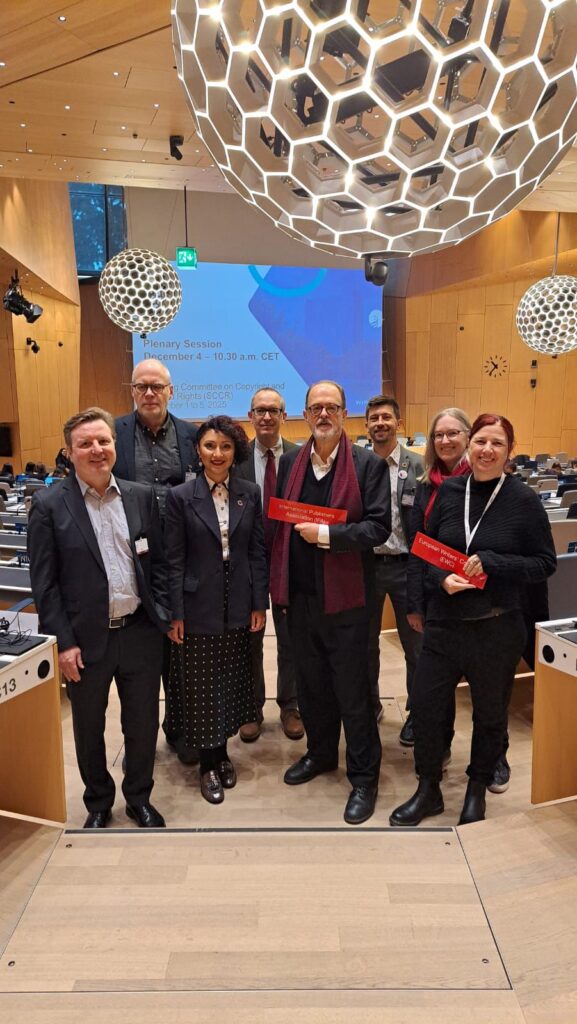
SCCR Chair Vanessa Cohen was back for day four and picked up the pace set by Vice Chair Labody on Wednesday.
First up from Other Matters were the two proposals for studies on remuneration of audiovisual authors and performers respectively, presented by the Africa Group. Member State reactions followed and the Chair adopted both proposals. Murmurs of surprise followed and USA took the floor to express their support for the former but not the latter, while Brazil countered by saying that they supported both together or neither. Further discussion will be required tomorrow.
Quickly on to the next item, the work on Theatre Directors. The secretariat delivered a brief report on its ongoing research which was welcomed by the Russian Federation, the proponent of this item. The USA delegation was not quite in a position to support continued work and asked for 10 minutes for internal consultation. This item also remained pending.
Next up was the Canadian proposal for a study on copyright protection of technical standards, which had been tabled at SCCR 46. Non-normative in intent, this still failed to garner consensus and will be back on the agenda at the next SCCR.
That left enough time for the USA delegation to introduce two new proposals which it had tabled. First, a proposal for a study on cataloguing types of effective business models and economic opportunities for creators and creative industries in the digital environment that are made possible through the effective implementation of technological protection measures or TPMs. Second, a proposal to survey the impact of the creative industries upon the economic growth of Member States when they are supported by strong copyright protection and effective enforcement. These will be discussed in further detail at SCCR 48.
And with that most of the items originally scheduled for Friday had been discussed with further negotiations pending.
The afternoon saw another AI Information Session looking at visibility, transparency, licensing and remuneration.
The opening presentation was of the WIPO Artificial Intelligence Infrastructure Interchange (AIII) which had been expected to launch during this SCCR but will be delayed. The AIII was presented as a forum for creators, rights holders, innovators, AI developers and other experts to exchange ideas and explore practical solutions about what IP infrastructure for the AI age can and should look like. AI will not set policy or legal standards. Instead, it will be an incubator for dialogue about how technical systems and tools can effectively support creators, rights holders and innovators while also promoting the development of AI technology.
The formal launch event of AIII is scheduled for 18 March 2026 and will be a one day program in Geneva and online.
Tobias Bednarz, Legal Counsellor of WIPO’s Copyright Law Division then introduced Daniel Gervais (Milton R. Underwood Chair in Law, Vanderbilt University, Nashville, Tennessee, and 2019 Charles Clark Memorial Lecture speaker) who delivered an insightful look at the functioning of Generative AI tools and how they may involve reproductions.
The following panel mixed creators, producers and representatives of platforms and governments who all presented their takes on how to tackle Generative AI, whether that be stakeholder dialogue for a government, using AI as a creator, filtering out AI slop as platform (although interestingly with no interest in labelling AI-created content), or supporting artist in their use of AI as a producer.
After a short coffee break, the second session opened with Gervais delivering a round-up of the legal environment around AI and the differentiations across multiple jurisdictions.
Rafael Ferraz Vazquez, Legal Officer of WIPO’s Copyright Law Division then led the second round of discussions, this time with a series of Member State perspectives from Korea, Brazil, Spain and Denmark, as well as views from News and Magazine publishers, Music Publishers and an AI licensing and protection platform. The Member States all delivered interesting approaches to engaging with stakeholders, and identifying how to support creative sectors. The rightholder speakers underlined how licensing solutions, based on artist consent, can bring benefits to creators, consumers and platforms.
The engaging presentations left Gervais jokingly acknowledging that he had 30 minutes of reactions but,reading the fatigue in the room, he chose instead to acknowledge that agentic AI will probably end up monitoring generative AI. He also identified the legal challenge of securing output-based remuneration if the outputs are complex composites of individual training works.
With a few final words, Deputy Director General, Sylvie Forbin, closed the wide ranging and informative session and let the delegates out into the Geneva night.