
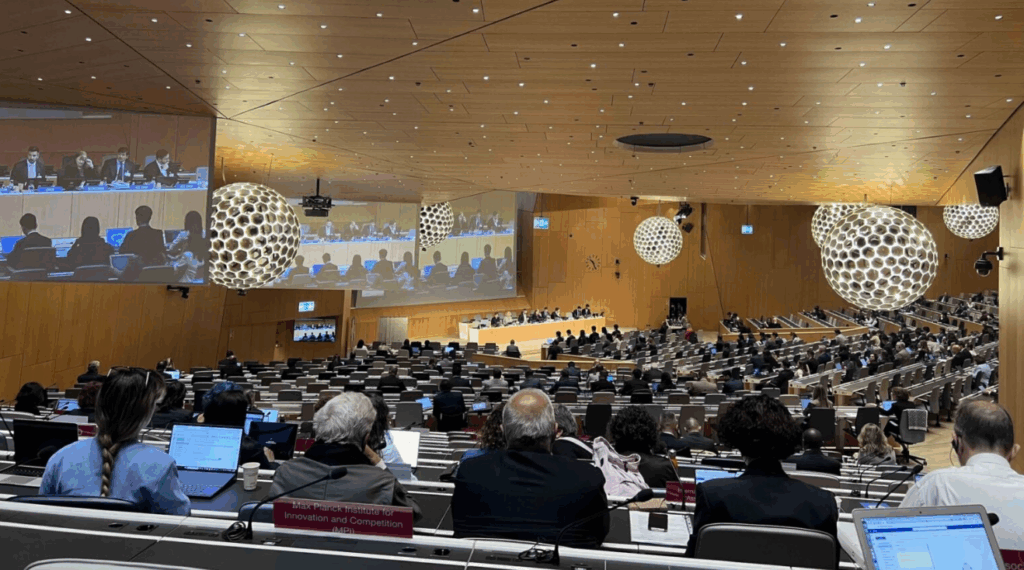
The week opened with renewed discussions on the long-running Broadcasting Treaty. Despite minor revisions to the draft text presented by Jukka Liedes, Member States remained far from consensus. The African Group reiterated its position that negotiations on the Broadcasting Treaty and on Exceptions and Limitations should proceed in tandem, arguing that both issues should ultimately be finalized together. Interventions from Member States and observers throughout the session confirmed that substantial divisions remain for a possible diplomatic conference. Alongside the formal negotiations, side events highlighted the practical realities facing creators and cultural industries. A session organized by FIAPF focused on the financial risks assumed by independent film producers, with speakers from France, Lebanon, and Greece stressing that intellectual property rights remain essential to securing financing for films and audiovisual productions. Without reliable copyright protection, participants argued, many independent productions would never reach audiences.
The second day shifted attention toward licensing systems, exceptions, and limitations. An IFRRO-organized event on licensing in the text and image sector showcased perspectives from Africa, Asia, and Latin America, emphasizing the value of licensing and remuneration mechanisms to sustaining local cultural production and educational publishing, such as in the case of indigenous cultural creation. Speakers rejected the notion that access and remuneration conflict, instead presenting that remunerated local creators ensured the availability of locally adapted educational resources. Formal committee discussions on exceptions and limitations again revealed divisions. While some Member States maintained that the current international copyright framework is sufficient, others argued that additional international instruments remain necessary. During the discussions, IPA President Gvantsa Jobava reiterated the publishing sector’s view that the existing framework already provides adequate flexibility for Member States to support libraries, archives, educational institutions, researchers, and persons with disabilities.
On the third day, attention centered on the presentation of the Access Toolkit. The authors emphasized that the toolkit was designed as a non-prescriptive and non-normative resource rather than an advocacy document. The presentation explored how different legal systems address access needs for libraries, archives, and museums. While many observers welcomed the initiative, others warned against overly broad exceptions and stressed the continued importance of licensing systems and exclusive rights. The day also featured discussions on the evolution of performers’ rights since the adoption of the WIPO Performances and Phonograms Treaty, particularly in the context of digital music platforms. Another two side events shed light on the music sector. First, an event co-organised by AEPO-ARTIS, FILAIE, FIM, IMARA, and SCAPR looked at 30 years since the adoption of the WIPO Performers and Phonograms Treaty and how musicians’ rights had evolved with the advent of digital music platforms. Second, an event hosted by IFPI on the success of Latin music covering both the broad success of music from the region, with digital platforms contributing to acts going from national to regional and then international success.
IPA closed its third day with a major side event, which assessed the impact of copyright frameworks on publishing industries in Africa and Latin America. Publishers and authors from South Africa, Egypt, and Brazil described both the opportunities and vulnerabilities facing local publishing sectors, particularly in relation to ongoing discussions on exceptions and limitations at WIPO.
By the fourth day, negotiations became increasingly focused on concrete textual work. Chair Labody was tasked with preparing a document drawing from proposals by the African Group, the United States, and previous SCCR drafts, focusing specifically on preservation, education, and access for persons with disabilities. Discussions also addressed studies on remuneration for audiovisual authors and performers, though consensus on a proposed study concerning performers had still not been reached. The committee then turned to the Artist Resale Right, where divisions among Member States again persisted. Some delegations sought to establish the issue as a permanent agenda item, while others preferred continuing information-sharing on national systems without formal negotiations. Brazil voiced dissatisfaction over the organization of a related regional event, criticizing the lack of consultation within the SCCR framework.
A substantial portion of the fourth day focused on copyright in the digital environment and artificial intelligence. Indonesia presented its proposal on the governance of copyright royalties online, which generated mixed reactions among Member States. Professor Daniel Gervais then presented ongoing work on a scoping study examining legal and policy approaches to AI training and copyright, including issues of authorization, enforcement, and remuneration. The afternoon information session on generative AI reflected the growing prominence of the issue across creative sectors. Presentations from Member States, including India, Kazakhstan, Mexico, Saudi Arabia, and Vietnam, highlighted a wide range of emerging national approaches. Legal experts also reviewed the expanding body of litigation concerning AI and copyright in jurisdictions such as India, China, the United States, and Europe. Representatives from publishing, music, visual arts, news media, and audiovisual industries warned of the potential risks posed by broad AI training exceptions, particularly for educational and professional publishing markets already facing disruption from AI-driven platforms.
The final day featured a series of studies and proposals addressing the economic dimensions of copyright. The WIPO Secretariat provided an update on theatre directors’ rights discussions, while Canada’s revised proposal for a study on copyright protection of technical standards achieved consensus and will move forward. The United States presented proposals for studies examining both the contribution of creative industries to economic growth and the business models enabled by technological protection measures (TPMs).
Across the five days of SCCR/48, one theme remained constant: while Member States remained willing to engage in constructive discussion, there is still little agreement on the exact destination.