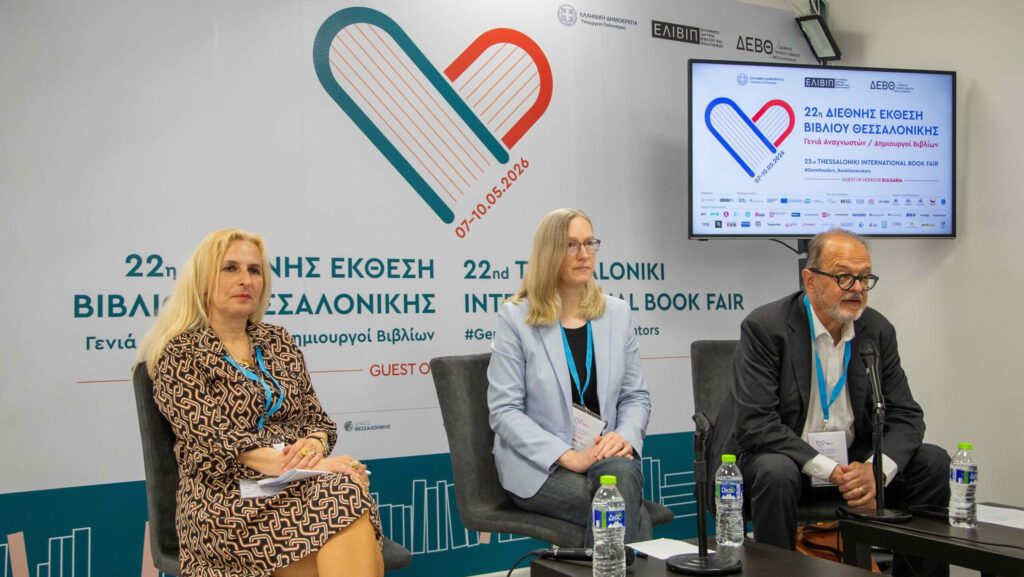
My name is José Borghino and I am the Secretary General of the International Publishers Association (IPA).
First of all, let me thank the Hellenic Foundation for Books and Culture (HFBC) for inviting me and my fellow speakers here today. Thessaloniki was one of the first book fairs I visited when I started working as the Policy Director of the IPA 13 years ago. The HFBC have invited IPA’s President (Gvantsa Jobava) and Vice President (Giovanni Hoepli) to speak here over the past two years, so I’m glad to help consolidate a strong, productive bond between the HFBC and us.
I have been asked to moderate today’s session. I will first introduce my two fellow speakers who will each speak for about 10 minutes and then we will open the panel to questions from you.
Today’s session is entitled ‘Challenges and New Legislations, Freedom of Expression’ and the blurb says:
This discussion will explore how emerging regulatory frameworks — such as the EU AI Act and related digital legislation — are shaping the use of AI in the publishing industry. Speakers will examine the balance between innovation, creators’ rights, and freedom of speech, analyzing how intellectual property can be protected and accountability ensured without restricting freedom of expression or editorial independence.
We will come back to this description shortly.
Our first co-speaker is Jessica Sänger, Director of European and International Affairs at the German Publishers and Booksellers Association; she is the current Chair of the IPA’s Freedom to Publish Committee; and the former Chair of the IPA’s Copyright Committee. Jessica will focus on Freedom to Publish and Freedom of Expression as it is impacted by current AI legislation.
And our second co-speaker is Dr Christina Banou, who is Professor in Book Policy and Publishing at the Ionian University, Corfu. Her main areas of research include book publishing, book policy, and the history of the publishing industry. Today she will bring an understanding of the history of the printed book to interpret where we might be heading in the future.
But first I will try to set the stage with some preparatory and possibly provocative statements.
This year marks the IPA’s 130th Anniversary and we now have 106 members in 85 countries. One of those members is ENELVI — a well-regarded publishers association here in Greece — and we work very closely with our European sister organisation the Federation of European Publishers (FEP), which also includes a number of Greek publishers associations. I’m happy to see both Costas Dardanos (President of ENELVI) and Phaedon Kidoniatis (Vice President of the FEP) here at the Fair.
IPA’s work is built on two pillars — copyright and freedom to publish. But we also work on other issues like educational publishing, accessibility, diversity, sustainability, and more.
Given our two pillars, I am very happy to be here talking about Challenges and New Legislations, Freedom of Expression.
In a few weeks, IPA will be announcing the shortlist of our Freedom to Publish prize — the annual Prix Voltaire which celebrates the bravery of publishers who persist in publishing works in the face of the disapproval, harassment and sometimes death threats from governments and others. We will do so at the World Expression Forum in Lillehammer, Norway, whose theme this year is ‘The freedom to disagree’.
And if you don’t mind, while I am in Greece, the birthplace of Western democracy, I will use my freedom to disagree here as well.
With all due respect, I want to disagree with the framing of our session today, a session for a publishing audience.
This framing wrongly pits new technology and copyright against freedom of expression by saying, ‘Speakers will examine the balance between innovation, creators’ rights, and freedom of speech, analyzing how intellectual property can be protected and accountability ensured without restricting freedom of expression or editorial independence’.
The word that is doing the heavy lifting in this sentence is ‘balance’. Pardon my cynicism (another good Greek word), but so-called ‘balance’ is what technology companies have been insisting on at every turn, for more than a quarter of a century. It is nothing more than a push for weaker copyright laws.
And this push is coordinated at a global scale: European legislation, legislation in the UK, in Singapore, Japan, New Zealand, Australia, South Africa, Korea, Kenya, Thailand. Pick a jurisdiction and you will see efforts by Big Tech and their lackeys to carve out a little more of copyright here, a little more there, one exception and limitation at a time.
And we see this at the World Intellectual Property Organization in Geneva where the pressure on copyright, and the international treaties that underpin it, is constant and growing.
Is it ‘balanced’ that Big Tech companies can scrape the internet and harvest trillions of words from pirated works to feed the insatiable appetite of their Large Language Models?
One way of approaching the AI revolution is through the astronomical numbers it has thrown up. For example:
The generative AI landscape is expected to grow by 47% from 2024 to 2030, reaching US$356 billion. Long-term forecasts push the boundaries further, with Bloomberg estimating the market will surpass $US1.3 trillion globally by 2032.
The numbers become increasingly outrageous. According to The Guardian in late 2025, Google announced it planned to spend $US85 billion on its AI and cloud infrastructure in 2025 and expects to increase spending again in 2026. Three more tech giants — Meta, Microsoft and Amazon — reported that they have collectively spent $US155 billion on AI infrastructure in 2025. For the coming fiscal year, Big Tech’s total capital expenditure gets even bigger: Microsoft plans to spend about $US100 billion; Meta plans to spend between $US66 and $US72 billion; and Alphabet plans to spend $US85billion. Amazon estimated that its 2025 expenditure would come to $US100 billion. In total, according to the Wall Street Journal, the four tech companies will spend more than $US400 billion in 2026.
The sick joke is that these mega-corporations continue to spend unbelievable amounts of money at the same time as they maintain that they cannot afford to pay rightsholders for the content they have illegally scraped from the internet. The irony is not lost on the many workers whose livelihoods are threatened by the AI tidal wave. Is this what Big Tech means when they talk about ‘balance’?
So please, among ourselves, among publishing professionals, let us not frame our own conversations using Big Tech’s warped terms of reference.
Copyright and freedom of speech, and by extension the freedom to publish, do not need to be balanced against new technologies. The Berne Convention, the treaty upon which copyright is founded, is inherently balanced: it confers exclusive rights on creators and their agents like publishers and it allows for exceptions and limitations to those exclusive rights as long as those exceptions and limitations are themselves balanced and not over-broad.
As publishers and creators, your freedom of expression is very much the same. You can say whatever you want. Indeed, much of the scientific progress of the past 500 years is founded upon people saying things that were not considered appropriate. The Earth going around the sun? Evolution? In both cases, publishers backed these scientists against the intellectual climate of the day.
The biggest companies the world has ever known are the technology companies that dominate our lives. They do not want to pay to use your works, they do not even want to try. They want to train their artificial intelligence writing machines using your books. They want to use your books because they value them; they know that your books are the best sources of professional, carefully edited writing. They know this, but they refuse to pay. Is this ‘balance’?
Now, let me recognize the very real conflict that publishers face. These new, revolutionary tools are built on the theft of our works. But, publishers have long been adopters of new technologies, always looking for new ways to bring the best stories to readers. And publishers are already using AI in our businesses. So, opposing the theft of our works does not preclude us from using these new technologies. The difference is publishers pay for the privilege. Big Tech does not.
So the big technology companies do not want to respect your rights or your business model.
These companies refuse to take responsibility for what is on their platforms and act as if the ‘algorithm’ exists in isolation and receives no instruction. These algorithms drive polarisation and feed not on healthily expressed disagreement, but peddle anger and opposition. All in the name of ‘free expression’; the same ‘free expression’ that was used as an excuse for the storming of the Capitol building in Washington DC on 6 January 2021.
Publishers on the other hand take full responsibility for what we publish. We are fully accountable, we print our addresses on the inside of each book. You can challenge us in court.
We should not stand for these false binaries: Innovation versus freedom of expression. Innovation, if it’s to be sustainable, should respect freedom of expression. It should respect copyright.
So what should a country with a small-language market do? Governments are falling for the Big Tech rhetoric, which trumpets: give us all your content for free or you’ll be left behind. But there is another way.
Governments can work closely with publishers and other creators to develop models that acknowledge the source of copyrighted works and pay for the use of those works. Add to that, everything that is in the public domain and you begin to create a corpus of words that is sustainable. One startling data point is that AI companies are running out of words. It is estimated that original data useful to AI companies and available on the Internet will run out by 2026: they are using it up faster than it is being created. Well, a system that helps create new works by paying for the use of already created works would be one way of helping solve that dilemma. That sounds more like ‘balance’. And it sounds remarkably like copyright.
It is vital that we fight for these two core principles of our sector. Copyright and freedom to publish. It is vital to support your publishers’ associations in your country, but also your regional association, the Federation of European Publishers, and that you support all of us by telling us about new government consultations, new legislative proposals.
We must collectively take the case to your governments who will fear being left behind in the AI race, who will be willing to sacrifice their own publishers and creators for quick progress in the short term and the illusory promise of a few data centres on your soil.
We need to fight together, because if you don’t fight, you lose.
And, despite all the resources the big technology companies have, you can still fight. And win.
Our Swedish member has recently secured a proper deal to reward creators as part of a Swedish AI Large Language Model.
Our British member coordinated with the broader creative industries and the British media to stop the UK government weakening copyright. They orchestrated broad public support for creators’ rights and the government couldn’t ignore it.
In October last year, Australia became the first country in the world to rule out a copyright exception for AI platforms. That was a result of an intense campaign by a coalition of creative sector organisations including our member, the Australian Publishers Association.
Our member in the USA is dilligently supporting publishers in the courts fighting dozens of cases against AI platforms, and the IPA has contributed two amicus briefs as part of those battles.
Our member in France is supporting a presumption of use of creative works in the training of AI tools.
There are a growing number of these examples. The key is to work together and to remember that copyright is the balance in the system and the guarantee of a sustainable ecosystem in the future producing new, challenging and inspirational works of human creation.
And the IPA will be here to support you.
Thank you.