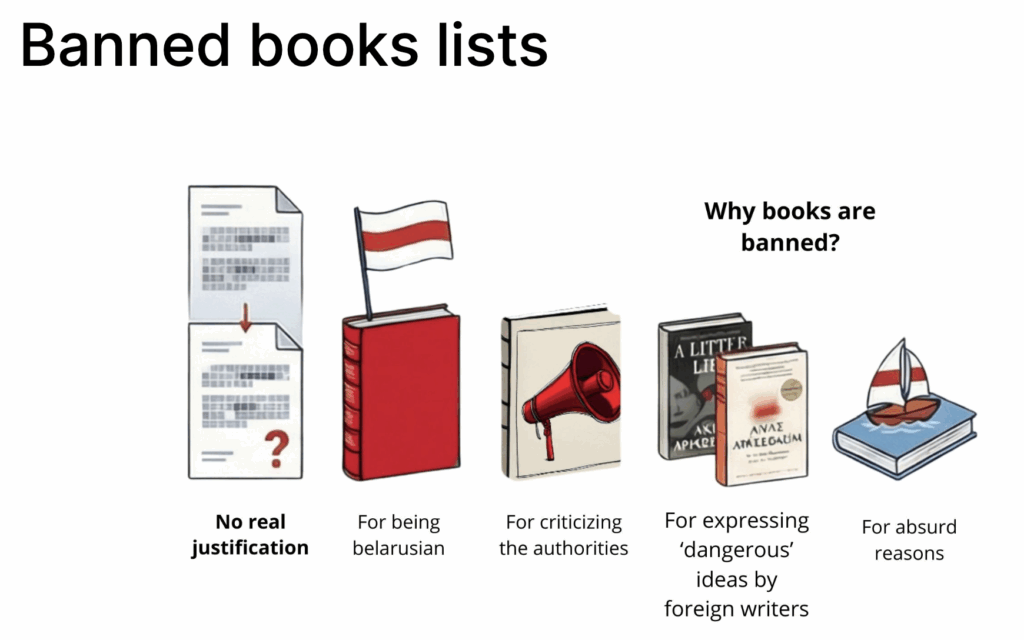
PEN Belarus classified the banned books into 3 lists:
- “Extremism Materials”: Works of fiction, historical, and academic literature that have been designated as “extremist materials” since 2020.
- “Harmful to National Interest”: List of printed publications that, according to the authorities, “may harm the national interests of the Republic of Belarus”. The list is published on the website of the Ministry of Information. USA – 60, Russia – 44, United Kingdom – 25, Japan – 12, Belarus – 6, Sweden – 5, Ireland – 3.
- “Informal banlist”: A system of non-public bans operating entirely outside any legal framework. It does not rely on official lists or court decisions. Instead, it functions through verbal orders, anonymous “commissions,” and an atmosphere of all-pervasive fear. It is a “phantom list” that cannot be challenged, because formally it does not exist. Books simply disappear.
During the launch event, Banned People: How Writers and Journalists Work in Belarus, Where Independent Work Is Branded “Extremism”, organised by PEN Belarus, authors and journalists shared powerful testimonies about life and publishing under the authoritarian regime. Accusations of extremism or links to terrorist groups are used to silence anyone attempting to disseminate independent information, as happened with journalist Yauhen Merkis, who was sentenced to four years in prison on extremism charges after covering nationwide protests following the 2020 presidential election.
Belarusian journalists and writers have been banned from the country without any legitimate justification. The government continues to place them on punitive blacklists based on vague and arbitrary criteria. Journalist Larysa Shchyrakava, for instance, was convicted to three and a half years in prison on charges of “discrediting Belarus” and “facilitating extremism”. She is now living in exile.
Many others have also been forced to flee, including Belarusian publishers Nadia Kandrusevich (Koska) and Dmitri Strotsev (Hochroth Minsk), who were jointly awarded the 2025 International Publishers Association’s Prix Voltaire for their resilience and commitment to freedom of expression.
The IPA will soon announce its call for nominations for the 2026 IPA Prix Voltaire and the Freedom of Expression Defenders Award.