
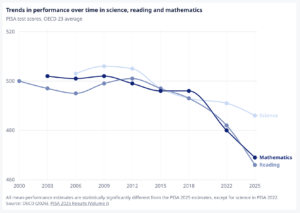
In 2025, more than 760 000 students, representing around 33 million 15-year-olds across 91 countries and economies, participated in the PISA assessment. The overall performance of OECD countries declined, with the lowest average levels of performance ever observed in science, reading and mathematics. Among the reasons cited to explain this global phenomenon are socio-economic disparities, attitudes toward learning, the role of digital technology, remaining effects of COVID-19, and a lack of parental involvement.
Reading recorded the steepest decline, with scores falling by 28 points across OECD countries and by 16 points among non-OECD participants between 2015 and 2025. The decline also occurred in skills that matter most in the AI age: evaluating information, making connections across multiple sources, and thinking critically about what we read. The instances of “hasty reading” – in which students read quickly but inaccurately – nearly doubled to 9% between 2018 and 2025. In reading, increased digitalisation, longer screen time and falling rates of reading for enjoyment have coincided with weaker literacy outcomes. Countries with the largest declines in reading also tended to record the largest drops in mathematics and science.
Andreas Schleicher, the director for education and skills for the OECD, said: “We cannot say for sure, but declining levels of reading for enjoyment and the shift towards digital reading—skimming social media feeds and rapidly processing information—may be compromising the ability of students to engage with complex texts and data”. In Denmark, Christine Bødtcher-Hansen, Director of the Danske Forlag, also commented on the issue: “The results from the international reading survey PIRLS unequivocally indicate that what affects pupils’reading skills is their leisure reading of fiction. Therefore, it is important to have the school library as a heart in schools, because not all children encounter the literary universe at home.”
According to PISA data, students who use AI for specific school tasks (such as summarizing texts, drafting, or conducting research) tend to score lower in science compared to those who do not use AI. On average, students who avoid using AI outperform their peers who do by about 20 points, which is roughly equivalent to having one additional year of schooling. In contrast, students who use AI weekly for general purposes achieve similar performance levels to non-users. Additionally, those who regularly utilize AI for general tasks and receive school opportunities to develop their AI literacy skills tend to score slightly higher in science. However, access to these educational opportunities is often more prevalent among socio-economically advantaged students, which raises concerns about a widening divide in AI literacy.
In this regard, Sebastian Guggolz, Chairman of the German Publishers and Booksellers Association, stated: “What we are currently observing in the book market is also reflected in the results of the competence measurement. Declining book purchases among young people and the weak PISA results on reading literacy are parallel developments that draw attention to a common underlying problem: Many young people in Germany do not reach the level of literacy they need for self-determined participation in education and society. The reasons for this are manifold. Digital, visual media, a flood of streaming services, and the rapidly increasing use of generative AI are changing the media use of children and young people and have a devastating effect on the lack of early reading promotion. However, it is also clear that reading literacy in Germany is not only a question of the preferences or talents of individuals, but it is structurally weakened and is still quite blatantly linked to social background.”
The PISA report emphasizes that teachers play a crucial role in the success of education systems. They must possess strong teaching skills that go beyond just subject knowledge; they also need practical abilities to explain concepts clearly, manage a classroom effectively, and keep students engaged and motivated. Additionally, resources should be tailored to meet the needs of disadvantaged students and schools. As artificial intelligence becomes integrated into the classroom, it should be used strategically to provide feedback and personalized practice. AI should enhance students’ active learning rather than replace it, as true understanding comes from critical thinking and engagement, not from having a tool do the work for them.
On this point, David Edwards, Education International General Secretary, stated: “The results of PISA 2025 come as no surprise to anyone who’s been paying attention to the situation in education. Our students are growing up in a world constantly vying for their attention, a world full of distractions and lacking connection. While the global teacher shortage remains unaddressed, AI is being pushed as the magic solution when in fact excessive use results in children outsourcing their learning and their thinking to a bot. Now more than ever, students need teachers. We need to rethink education and strengthen its social core – the fundamental student-teacher relationship”.
Danske Forlag also pointed to the need for an increased focus on quality in teaching, including investments in professionally developed quality teaching materials, as research shows that quality teaching materials contribute positively to the quality of teaching and the students’ learning outcomes, and they should therefore be included as a central part of the efforts that follow the historically weak PISA results. Finally, Mathias Cormann, OECD Secretary-General, declared: “PISA 2025 shows that reversing declines in student performance is urgent. The most successful education systems focus on fewer areas in greater depth, invest in teachers, engage parents and provide targeted support for the students and schools that need it the most.”
Read the full report here.