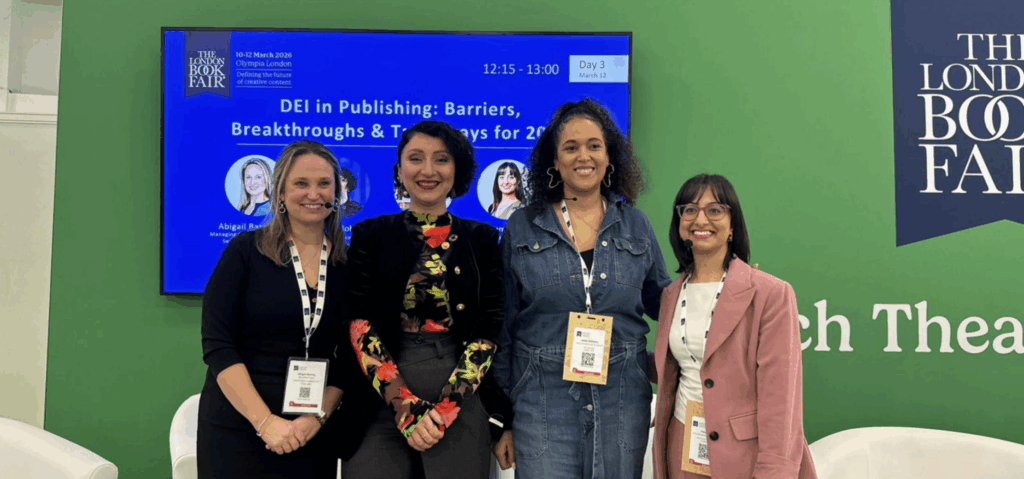
After a morning of meetings, IPA was involved in its first panel of the day on “DEI in Publishing: Barriers, Breakthroughs & Takeaways for 2026” at the Tech Theatre. Moderated by Abigail Barclay (Managing Director, Inspired Search & Selection), the panelists included Gvantsa Jobava (IPA President), Jodie Williams (Head of DEI and Social Impact, Pan Macmillan), and Iram Satti (Global Belonging and Inclusion Manager, Bloomsbury).
Iram Satti kicked off the conversation, arguing that progress has been made in terms of diversity, equity, and inclusion (DEI), but that the industry must see this as a long-term commitment and not merely as a performative task. She mentioned that systemic issues can be difficult to identify.
Gvantsa Jobava exemplified it with the low numbers of women occupying IPA’s Presidency throughout the history of the organisation. In 130 years, Jobava is only the fourth female IPA president. According to her, while this number is far from exciting, IPA tries to advance the DEI agenda within its committees, such as in the Executive Committee. In addition, IPA has partnerships with UN Women and promotes valuable initiatives, such as PublishHer, to its network of 107 publishers’ associations in 85 countries.
Continuing the conversation, Jodie Williams highlighted the Black British Book Festival and stated that the publishing industry must have a proactive approach to bring the DEI agenda forward.
This was followed by the panel “Ready or Not: Accessibility legislation in US and EU and What Publishers Must Know” at the Main Stage. Moderated by Simon Mellins (Director, Simon Mellins Consulting), the panelists included Stacy Scott (Head of Accessibility, Taylor & Francis) and Cathy Felgar (Executive Director, Publishing Operations, Princeton University Press).
The well-attended 30 minute session delivered a clear vision of what had been achieved so far for the European Accessibility Act (EAA) and how that differed from what might be necessary to comply with Title 2 of the Americans with Disabilities Act (ADA) which will come into force in April. The consensus was that EAA compliant publishers were well on their way and that while Title 2 only applied to public entities in the US, that did mean public libraries or State universities could require compliance from publishers. The discussions covered relevant standards. Web content accessibility guidelines (WCAG) as well as the need for quality metadata. The session closed with an enthusiastic call for interested attendees to join the PAAG (Publishers Accessibility Action Group).
And with that, the IPA’s business at the last London Book Fair in the Olympia started winding down. Next time at Excel!