
A study conducted by leading economists at Secretariat Advisors, Jéssica Dutra and Robert Stoner, is titled “An Empirical Study of the Impact of Library E-Lending on the Book Economy: As Public Libraries Prioritize eBook Formats, Harm to Commercial Markets Across All Formats is Quantifiable and Significant.” It analyzes how the recent shift toward digital lending has affected the commercial book marketplace in the United States, particularly consumer sales essential to authors’ and publishers’ financial success.
Several states have attempted to pass legislation that provides special treatment for library e-books. However, this approach seems to conflict with the Copyright Act, which generally prevents state laws from interfering with copyright regulations. These state efforts may impose limitations on licensing fees, reduce the number of copies available to libraries, or prohibit economically sensible practices like “windowing”, which refers to the practice of delaying library access to certain titles, especially new releases and bestsellers, during periods when demand is high and readers are most willing to pay. Such practices are common in many other creative content industries.
These state efforts undermine the commercial marketplace by requiring libraries to obtain more digital copies for less money immediately upon first publication, without considering the larger ecosystem. This financial impact will be felt by authors and publishers whose livelihoods and business models rely on strong and sustainable revenue streams. Additionally, bookstores and local economies will experience lost revenues, and consumers will ultimately face a reduced supply of books.
Shifts in the library marketplace have affected consumer behavior and commercial markets. Even where print remains the preferred format for purchase, some readers may still shift to reading digitally when library access makes the digital option easy, immediate, and free. According to the Institute of Museum and Library Services (IMLS), e-books have surpassed printed materials in library collections since 2020, as shown in the figure below:
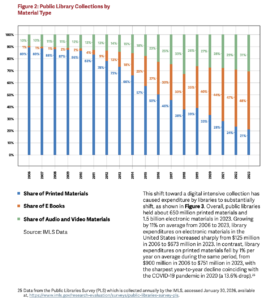
The research concludes that greater access to e-books through library apps affects consumer behavior and has implications for commercial markets in both physical and digital formats. The study provides strong evidence of a direct substitution effect between library e-lending and retail sales. It also suggests that lowering library e-book prices or implementing certain changes to licensing terms, as mandated by recent state legislative initiatives, could further negatively impact commercial markets.
The following is a joint statement from Maria A. Pallante, AAP President and CEO, and Mary Rasenberger, Authors Guild CEO:
“This expert study will be of critical interest to everyone who cares deeply about the future of books, including the authors who write them, the publishers who invest in them, and the booksellers and librarians who promote and deliver them to readers and communities across the country through a dynamic variety of formats, distribution channels, access models, and price points designed to give each book its best shot at success for as long a period as possible.
For state legislatures that seek to intrude into the literary marketplace by singling out e-formats for government mandates, the study addresses the significant economic consequences likely to result from such actions. It is a central tenet of copyright that licensors and licensees should individually negotiate their terms in competitive transactions that are free of government regulation by state or local governments. This time-tested legal framework has built a U.S. creative economy and book supply that are world-renowned, but which should not be taken for granted.
We note that many if not most libraries are inadequately funded for their outsized missions and collection needs in contemporary society, but the solution is not to upend the book marketplace. Rather, fully funding libraries should be an urgent priority for all lawmakers, and the Authors Guild and AAP stand firmly behind efforts that would increase taxpayer funding at every level of government and support new ideas for private sector support. It should be obvious to policymakers that both the mission of libraries and the intellectual property of authors and publishers are equally invaluable to the public interest, not a tradeoff.
As a matter of law, it is incontrovertible that state governments lack constitutional authority to contradict our national copyright system for books or any other protected creative expression, which is the exclusive province of the U.S. Congress. In short, the key to the future of books across all formats will not come from the statehouse but from ongoing private sector innovation and more numerous and varied business models that are the result of nimble and competitive marketplace negotiations. It is our view that debates in the states, frequently accompanied by misinformation about law and facts, have not assisted the discussions between licensors and licensees but rather polarized and confused them.
We believe this study presents new information that points to the importance of a healthy book economy that is able to reflect and respond to complex digital markets with an eye to the future, free of one-size-fits-all mandates or artificial terms that ask the private sector to subsidize the state. In this moment, as creators throughout the world face enormous harm from AI-generated products that have infringed their works on a mass scale and now compete with them for sales, the common cause of authors, publishers, libraries, and booksellers—to get more people reading and more books into the hands of readers—has never been more important.”
About the Study:
This study is the work product of Jéssica Dutra, Ph.D. and Robert Stoner, Ph.D. of Secretariat Advisors. Undertaken at the request of the Association of American Publishers and the Authors Guild, the study’s empirical analyses and all findings belong entirely to Secretariat Advisors. Secretariat Advisors is a global expert witness, litigation consulting, and economic advisory firm trusted to address complex legal, risk, and regulatory matters. Read more at secretariat-intl.com.
The full study is available here.
About AAP
The Association of American Publishers (AAP) represents book, journal, and education publishers in the United States on matters of law and policy, advocating for outcomes that incentivize the publication of creative and intellectual expression across a variety of formats and business models in support of an inspired and well-read democracy. AAP fights vigorously for the copyright and freedom of expression protections that have been the lifeblood of American publishing for more than 250 years, from the printing press to digital markets. Comprised of small, large, independent, scholarly, commercial, and nonprofit houses, AAP’s members collectively cultivate and publish a vast body of literature by both new and established authors, including winners of every major writing prize. Learn more at publishers.org.
About The Authors Guild
The Authors Guild is the nation’s oldest and largest professional organization for published writers in the United States, with a particular expertise and long history of involvement in freedom of expression protections and copyright law, which together are the constitutional and economic bedrock of authors’ livelihoods. With over 18,000 members, the Authors Guild advocates for authors’ rights and fair pay, and protects against challenges such as infringement, censorship, book bans, the misuse of AI, and nonpayment. In addition to engaging with legislatures and the courts on behalf of all writers of every level of achievement, the Authors Guild offers resources, legal support, and a professional community to individual authors to help sustain their careers and thrive in an evolving literary landscape. Learn more at authorsguild.org.