During the recent Bologna Fair, I had the pleasure of meeting Ana María Cabanellas and embracing her in celebration of her receiving the PublisHer Lifetime Achievement Award. The International Publishers Association (IPA) shared the following on LinkedIn: “With a career spanning more than five decades, she has demonstrated outstanding leadership, shaped the global publishing landscape, and created opportunities for others across generations. Her work reflects a lasting commitment to excellence, diversity, and the development of the publishing industry worldwide. At 80, she continues to publish, teach, and inspire an enduring example of dedication and impact.” There is little more to add.
Bologna is always a moment when I feel the full intensity of the world of books: reunions with colleagues I first met over two decades ago; the sheer variety and brilliance of human creativity, vividly reflected in publishers’ stands and illustrators’ work; and the discoveries that come from listening to people I encounter for the first time.
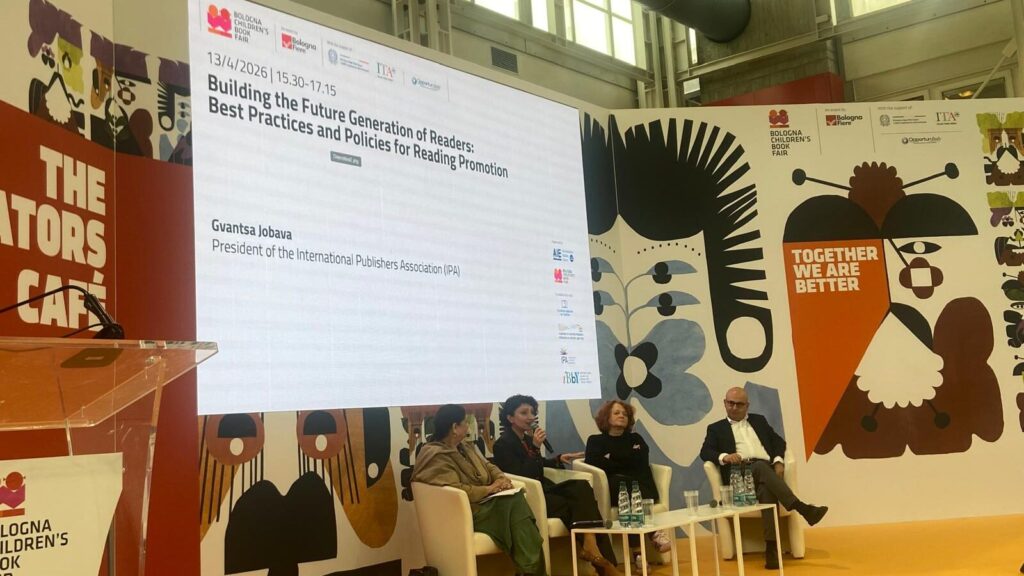
On the first day of the fair, an event took place in the emblematic Illustrators’ Café, a central space within the fair. It was titled *Building the Future Generation of Readers: in Bologna, the international event for a new pact on reading promotion*. The Italian Publishers Association (AIE) and the Bologna Children’s Book Fair (BCBF), in collaboration with the French Syndicat national de l’édition (SNE), the Federation of European Publishers (FEP), the International Publishers Association (IPA), and the International Board on Books for Young People (IBBY), organised an international conference to showcase and encourage the dissemination of the world’s best practices in reading promotion, as well as to reflect on the role of European and international policies. I had the honour of being appointed moderator of this forum.
Following the opening remarks by Elena Pasoli, the first session “Best practices for reading promotion” featured contributions from Gaia Stock, Agathe Jacon, Deagon Yi and Dan Conway. The second session brought together Mari Yasunaga, Basarat Kazim, Gvantsa Jobava and Anne Bergman-Tahon to discuss their perspectives on public reading policies. After the closing remarks by Innocenzo Cipolletta, President of the AIE, I left trying to organise in my mind a kind of conceptual map of issues around literacy that are central to the organisation I lead, to many of us working in this field, and to this series of articles. Both this piece and the previous blog post are written under the influence of the torrent of ideas that emerged during the London and Bologna fairs, and I hope to draw on them to contribute new insights to this website in the coming months.
Ana María Cabanellas is my colleague in the management of the IPA Literacy Sub-committee, but we have shared professional experiences for many years. When I was working as a senior civil servant in Spain’s national public administration, responsible for R&D in the field of energy, I was selected to lead the unit within the Ministry of Culture responsible for promoting reading, the book industry and literature. One of my first experiences in that role was participating in the executive committee of CERLALC, an organisation based in Bogotá that operates in the field of reading and books across Spanish- and Portuguese-speaking countries. There I discovered that this field presents challenges very different from those found in other domains, with modes of working that are often highly fragmented. I will never forget Ana María’s clarity of vision in what was a rather complex context, and how everything gradually improved thanks to collaboration among people from different countries.
The promotion of reading must draw on learning opportunities from experiences in other countries and even from other industries. If, as Karl Popper wrote, “to live is to learn”, I do not regret having once proposed the concept of “R&D for Reading”, even if at the time it may have seemed to some an eccentric or even absurd idea.