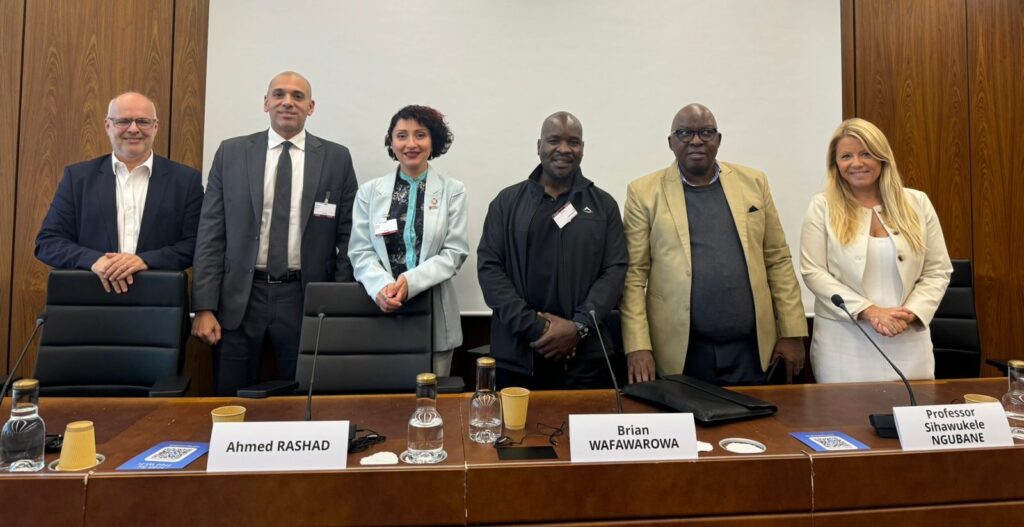
At the 48th session of the Standing Committee on Copyright and Related Rights (SCCR) at the World Intellectual Property Organization in Geneva, the International Publishers Association hosted a side event titled The Importance of Copyright for African and Latin American Publishers. Composed of Gvantsa Jobava, IPA President; Catriona MacLeod Stevenson, Co-Chair of IPA Copyright Committee and General Counsel & Deputy CEO of the Publishers Association; Brian Wafawarowa, CEO of the Juta and Company (Pty) Lta; Professor Sihawukele Ngubane, author and chairman of the Academic and Non-Fiction Authors Association of South Africa (ANFASA); Ahmed Rashad, Executive Director Dar Al Masriah Al Lubnaniah; and Dante Cid, VP Academic Relations Elsevier and President of Brazilian Publishers Association (SNEL); the event discussed the fragility of publishing ecosystems in emerging markets in Africa and Latin America and the risks posed by broad copyright exceptions and weak enforcement frameworks.
Opening the event, Gvantsa Jobava emphasised the importance of ensuring that African and Latin American perspectives remain central to global copyright debates. She noted that the IPA has members in 85 countries, many of them located in Africa and Latin America. She highlighted the significance of bringing publishers and scholars from these regions into conversations taking place at WIPO. Moderating the discussion, Catriona MacLeod Stevenson framed the conversation around both the enormous potential and the structural vulnerabilities of publishing markets in the Global South. Referring to a recent UNESCO report on Africa’s book industry, she stressed that Africa currently represents less than 6% of global publishing revenue despite accounting for nearly one-fifth of the world’s population. She stated: If the right policies are in place, Africa’s book industry alone is projected to become an $18.5 billion market. Yet, Stevenson warned that educational publishing dominates many of these markets, comprising between 70% and 90% of industry activity in some regions. Because of this, policies that weaken copyright protections in the name of educational access could unintentionally destabilise entire national publishing ecosystems.
That concern was echoed by Brian Wafawarowa, who provided an overview of the publishing landscape in Sub-Saharan Africa. While acknowledging the progress made over recent decades, including the rise of locally produced educational materials and stronger indigenous publishing industries, he warned that publishers across the continent face mounting uncertainty. Wafawarowa described how some governments have imposed restrictive educational procurement systems, reduced competition among publishers, or even demanded the transfer of copyright ownership as a condition for participating in state programs. He stated: we are facing uncertainty and quite an alarming decline despite the progress that we have made. The [UNESCO] report correctly emphasises that the absence of appropriate policies is a major setback in this situation. But what I think the report doesn’t go into is the role of dissonant and detrimental policies. The history of the book sector in sub-Saharan Africa can be described as sporadic episodes of growth and decline on the fortunes and misfortunes triggered by policy. Wafawarowa then argued that the debate around copyright exceptions cannot be detached from the economic realities of African publishing markets, where educational books constitute the financial backbone of the industry. In this context, he said, educational exceptions are not marginal adjustments, as they strike at the core of the sector itself.
Wafawarowa also drew attention to the widespread unauthorised use of educational materials, particularly in higher education. According to him, rampant piracy, digital file-sharing platforms, and weak enforcement mechanisms have already led to the collapse of longstanding academic bookstores and discouraged authors from continuing to produce new editions of educational works: I believe that every student in the higher education system has material that they are using, but the majority of that material is unauthorised usage. So we are in a situation, for example, where most of the international publishers in higher education have folded and left, and the local ones have stopped. And it’s becoming increasingly difficult to get to a point where you can persuade an academic to write the second edition third edition of a work, because the question is what for? I didn’t get anything from the first one. So we are really facing an existential crisis for that sector, and we’re getting to a point where there is a crisis in knowledge production and dissemination as a continent at a time where we are pitched to have the majority of young people living on the continent by 2050.
The discussion then turned to the perspective of authors, with remarks from Professor Sihawukele Ngubane, who spoke about copyright reform in South Africa and the proposed Copyright Amendment Bill currently under judicial scrutiny. Ngubane emphasised that copyright remains essential not only as an economic mechanism but also as a form of moral recognition for creators. Speaking from the perspective of African authors, he linked copyright protection directly to broader efforts to decolonise education and promote indigenous knowledge production.
For Ngubane, strengthening local authorship and ensuring fair compensation for creators are inseparable from cultural transformation: Copyright is fundamentally important as the legal foundation that recognises and protects the value of creative labour, enabling economic sustainability and moral recognition for creators. It grants authors exclusive rights to control reproduction, distribution, adaptation, and public performance of their works. […] [indigenous knowledge] has been marginalised in such a way that our knowledge was not circulating. It was ignored, including our names. Some people were asking me about my name, Sihawukele. It means have mercy upon us. But I was not allowed to use my Zulu name at school. I was given the English name or the biblical name. So we are in the era of transforming our content, our knowledge. That is why we say that the knowledge that we want to pass on to our new generation should be written by the real owners of the knowledge. That is why we want to have local authorship, people who are rewriting the content. The most common term that is used is decolonising education. Authors are busy coming up with new works on the new transformative content for our students and schools. So those are the two main points, protecting authors and improving access to universities, schools, for libraries and galleries, publishers, authors, and researchers. We know that publishers can never exist without us, the creators, because they will have nothing to publish.
At the same time, Ngubane acknowledged the need to modernise South Africa’s copyright framework, originally enacted in 1978, to respond to digital realities and improve access to knowledge. However, he warned that some proposed reforms, particularly broader fair use provisions, could severely undermine educational publishing and reduce already fragile revenues for local authors: The new bill proposes to replace the existing fair dealing provision with a new Section 12A on general exceptions from the copyright protection. It expands the circumstances under which copyright material can be used without compensating the copyright holder. The uses of copyrighted works in education will not amount to copyright infringement. The key argument is that the proponents believe in the hybrid framework that would lead to flexibility. While critics, mainly authors and publishers, contend that it is too open-ended. Risk market substitution for educational materials, reduced licensing revenue and harms local creators and the publishing industry.
From a North African perspective, Ahmed Rashad highlighted the rapid growth of publishing industries across countries such as Egypt, Morocco, Algeria, and Tunisia over the past fifteen years. Yet he argued that copyright enforcement and legal reform have failed to keep pace with the expansion of content creation. According to Rashad, governments often move slowly on copyright amendments, especially concerning digital issues, while enforcement agencies lack sufficient resources to combat piracy effectively. He described a regional pattern marked by weak enforcement, limited dialogue with private publishers, and tensions between public access objectives and copyright protection. Economic instability, particularly in Tunisia, has further intensified both physical and digital piracy. Rashad expressed concern that, despite these ongoing structural problems, discussions at WIPO continue to prioritise new copyright exceptions and limitations.
The Latin American perspective was presented by Dante Cid, who underscored the scale of piracy in the region and called for stronger WIPO support for enforcement efforts. Cid also focused on the role publishing plays in promoting cultural, ethnic, and religious diversity. He noted that recent years have finally seen greater inclusion of minority voices in both educational and literary publishing across Latin America, and criticised the exceptions for education: When somebody proposes to create exceptions for education, the first victims of such a policy would be those small publishing houses that are just growing and offering spaces for these minorities. Using Brazil as an example, Cid described the country’s large-scale public educational book procurement system as a successful model that balances public access with sustainability for publishers. Under the program, publishers supply books to public schools at near-cost prices, while benefiting from the scale and predictability of government purchasing.
The conversation also addressed the growing implications of artificial intelligence for publishers and creators. Wafawarowa warned that emerging AI regulations in several countries increasingly propose exceptions for text and data mining without sufficient guarantees for compensation, competition, or transparency. Cid reinforced this point by questioning how AI systems can produce reliable outputs if they are trained on unverified or low-quality materials. He argued that the value of AI ultimately depends on professionally produced, high-quality content created by authors, researchers, and publishers: Quality does not just happen. Somebody invested their time professionally to create such quality material. And these efforts need to be compensated.
Throughout the event, speakers repeatedly returned to a central concern: while improving access to education and knowledge is an essential policy goal, weakening copyright protections in emerging publishing markets could undermine the very systems that sustain local authorship, educational production, and cultural diversity. The discussion at SCCR/48 ultimately revealed a shared message from publishers and authors across Africa and Latin America: access and creativity cannot be treated as opposing objectives. Sustainable access to knowledge depends on sustaining the creators, publishers, and local industries that produce it.
You can access a recording of the event here.