In recent times, a trend has become evident at professional book fairs: increasing time and effort are being devoted to discussions about strategies for promoting books.
At the recent London Book Fair, there were numerous references to the promotion of reading in our societies. The fact that the Year of Reading is currently underway in the UK may be seen as a trigger for this prominence within the fair’s programme. While this may indeed be a contributing factor, I do not believe it is the main reason behind the role that reading played over the three days of the fair. Reading promotion was present on the Main Stage at Olympia Kensington, but also in other forums, including “The Great Audiobook Debate” at the Tech Theatre.
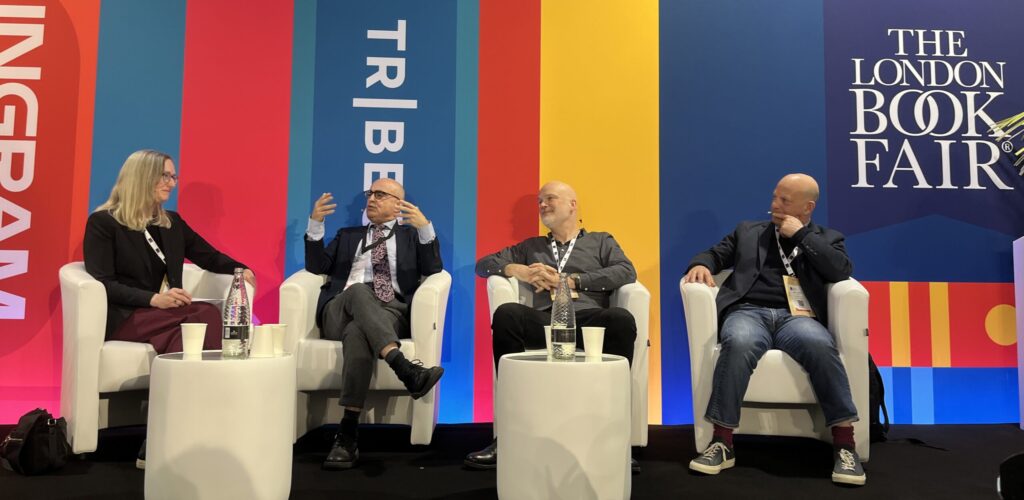
“Democracy Depends on Reading, Coalitions for the Future” was the title of a panel discussion in which I took part on the Main Stage of the London Book Fair, organised by the International Publishers Association, alongside Marc Lambert (CEO of the Scottish Book Trust) and the writer Arne Svingen, also International Secretary of PEN International. The session was moderated by Jessica Sänger, Director for European and International Affairs at the Börsenverein des Deutschen Buchhandels as well as the Chair of the IPA’s Freedom to Publish Committee. Jessica succeeded in encouraging us to combine reflections on our practical experience with the increasingly significant role of reading as an instrument for democratic coexistence.
And what place did reading promotion occupy in a forum devoted to audiobooks? As I have argued in my blogs on this website, it is crucial to develop a taxonomy of reading based on the situations, forms, functions, or media through which it occurs. Each type of reading can be supported by specific promotion policies.
We need a certain Aristotelian clarity to work more effectively. I therefore argued during the debate that listening is natural, whereas reading is not; that reading activates a different part of the brain; that reading is slower by design and that this is its strength; that reading trains higher-order thinking; that the reader controls the text, whereas the listener follows it. These kinds of equivalences, these kinds of unscientific confusions, weaken the defence of literacy and the concept of reading and we lose a precise term for a specific cognitive practice with unique intellectual and cultural impacts.
In short, it seems to me highly significant that at a professional fair -where the primary focus is business- time can be devoted to debating these issues, and that the audience is substantial.
The same can be said of the forthcoming edition of the Bologna Children’s Book Fair. On the afternoon of 13 April, an international conference on reading promotion has been organised at this emblematic professional event in the publishing sector, directed by Elena Pasoli. The Associazione Italiana Editori (AIE) and Bologna Children’s Book Fair, in collaboration with the Syndicat national de l’édition (SNE), the Federation of European Publishers (FEP), the International Publishers Association (IPA), and the International Board on Books for Young People (IBBY), will present an international conference dedicated to effective reading promotion practices from around the world and to the role of European and international cultural policies.
The event will offer an opportunity to explore some of the most successful initiatives currently underway at a global level, including those in Italy, France, Korea, the United Kingdom, and India. The second part of the conference will focus on proposals put forward by trade associations, with contributions from representatives of FEP, IPA, and IBBY, fostering a shared discussion on ongoing initiatives, future challenges, and the strategic priorities emerging from dialogue with European and international institutions, with the participation of leaders such as Gvantsa Jobava (IPA), Anne Bergman (FEP), Basarat Kazim (IBBY), and representatives of some public institutions. The conclusions of this international conference will be delivered by Innocenzo Cipolletta, President of AIE.
I am convinced that the afternoon sessions will be highly valuable for all those able to attend from 15:30 onwards. Within the programme of a B2B fair such as Bologna, a number of best practices will be presented and analysed, and there will also be discussion of European and international initiatives and policies for reading promotion. It is as though a general consensus were emerging: that it is essential to learn from others and to build alliances of the widest possible scope at a time of turmoil, in a context where major players from other industries are accumulating ever greater power by the second.