

Metadata management is an important aspect of publishing at any scale. It’s the key information about a publisher’s products that needs to be shared with the remainder of the supply chain – from the basic title, author, ISBN, cover image, publication date and price, to richer information like abstracts or summaries, contributor biographies, open access licenses, even manufacturing details for downstream POD, and details of international distribution arrangements. Metadata is often communicated via ONIX, a standardised and comprehensive data file format that publishers, retailers, libraries and various intermediaries use, across many countries. It encompasses bibliographic information about the book itself, but also the vital marketing collateral and commercial arrangements. If you’re unfamiliar with ONIX, there’s a 15-minute video briefing available at doi:10.4400/anjr. While ONIX is EDItEUR’s best-known standard, EDItEUR is also responsible for Thema (a subject category scheme that helps specify what a book is about) and a less well-known family of e-commerce standards called EDItX.
October was a busy month for EDItEUR, beginning with the Frankfurt Book Fair – the backdrop to EDItEUR’s International Supply Chain Seminar and its steering committee meetings that govern developments to our Thema and ONIX standards.
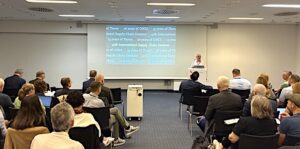
The Supply Chain Seminar – held within the Frankfurt Messe for the first time in a decade, on the day before the Book Fair opens – is a must for metadata and supply chain specialists in the book trade. As ever, the mini-conference focused this year on a range of standards, case studies and real-world practices. One theme for 2026 was the practical application of AI to a range of metadata-related tasks, but the presentation topics were wide-ranging – from linked data to updates for the EPUB 3.4 e-book standard to open access to novel retail models. The slides from almost all of the presentations are available from the EDItEUR website (https://www.editeur.org/3/Events/Event-Details/751). If you’re a metadata and supply chain specialist, mark your calendar for October 5th next year.
⁂
In late October, EDItEUR released Thema version 1.7, the latest update to its globally-relevant, multi-lingual subject category scheme.
This update was produced with the help of dedicated volunteers in an expert working group with representation from multiple countries and different parts of the book industry, then ratified by the Thema international steering committee at its meeting in Frankfurt. It is fully backwards compatible with all earlier versions of Thema, but introduces over 40 additional subject categories and 200 new qualifiers to the scheme. It also includes hundreds of minor changes to the wording of notes, for clarity and to aid translation. Full compatibility means existing Thema metadata for backlist titles does not need any modification, but each of the new categories and qualifiers provides an opportunity to provide a little more detail for some types and genres of books. Here’s a handful of examples of new options:
- FBAF – Dark academia fiction
- FKK – Folk horror
- JBFP – Social innovation
- JWE – Drone warfare / robotic warfare
- YFCG – Children’s / Teenage fiction: Young mystery solvers
- 5THM-MZ-A – Literature of Mozambique
- 5YW – Content has sexual activity that takes place ‘off the page’
If you click on these links, you can view notes associated with any of these codes by choosing the = button for each category. Right now, although the codes are universal, these and other new text headings and notes are only available in English – hey will be enriched with translations over the coming months.
The new code 5THM-MZ-A is an interesting one: v1.7 has ‘filled in the gaps’ within a large group of categories beginning with 5T… for the ‘literature of a country’. Note that these codes are not intended for literature about a country or the setting of a narrative – Thema has qualifiers beginning with 1… for that. Nor is it necessarily about the geographic origin of the creator – that could be carried in <ContributorPlace> in ONIX. The 5T… codes are intended to show the book is considered an important part of the corpus of literature of a place, a part of the culture of a place (see the notes attached to the 5T category – click the = button to see them). This ‘Literature of a place’ concept was introduced in version 1.6 of Thema, but v1.7 extends it to further places. It gives data recipients a further option to implement advanced facetted searches to help readers connect with books.
5YW was also the agreed result of extensive discussion within the Thema v1.7 working group. Many publishers have created their own ‘spiciness’ rating for romances with sexual content, often featuring a 🌶 to 🌶🌶🌶🌶🌶 ‘chilli pepper’ range, and there’s demand for a more universal approach to indicating the relative sexual excitement embodied in a book’s contents. But what’s ‘spicy’ in one culture may well be bland in another, so as an international scheme, Thema has adopted a distinction between implied and explicit sexual content (off the page / on the page), to supplement various pre-existing subject categories for erotica of various kinds.
Adoption of v1.7 by data senders is straightforward: A publisher’s system vendor or title management system developer needs only to add the new categories and qualifiers to their list of valid codes and menu entries. That should allow the new categories to be specified in ONIX like this:
<Subject>
<MainSubject/> <!– this is the most important of several Thema codes –>
<SubjectSchemeIdentifier>93</SubjectSchemeIdentifier> <!– 93 = Thema –>
<SubjectVersion>1.7</SubjectVersion>
<SubjectCode>JBFP</SubjectCode> <!– JBFP = Social innovation –>
</Subject>
Of course, the Thema code and version can also be communicated in other ways, for example in an Excel spreadsheet.
Adoption of v1.7 by data recipients is also expected to be relatively speedy, over the next several months. If a recipient has not implemented a particular new category, then stripping the final character from the code almost always gives a less detailed but still suitable subject – for example, YFC (a truncation of YFCG) is Children’s / Teenage fiction: Action and adventure stories, which has been a part of Thema since the beginning.
Thema has grown and ‘matured’ over the last decade or so of updates, and is now the preferred (or occasionally, mandated) subject category scheme across many countries. The entire scheme is freely available to all, from https://www.editeur.org/151/Thema for all documentation and data files listing all the categories and qualifiers, and from https://ns.editeur.org/thema for an interactive, multi-lingual browser that presents the scheme in hierarchical fashion. The online browser also includes the previous versions of Thema if you still need to use them.
The next revision of Thema, v1.8, is provisionally intended for release in late 2028, in line with Thema’s two year revision cycle.
If you’re brand new to Thema, do take note of the ‘six golden rules’ listed on the interactive online browser, and read the document Mythbusting Thema. There’s an executive briefing on Thema available too. The Thema codes a publisher selects for each book can then be communicated to the downstream metadata supply chain in ONIX, or via any other method.
⁂
The Frankfurt meeting of the ONIX international steering committee also led to a new issue – the 75th – of the ONIX codelists. Quarterly releases of these controlled vocabularies is vital in keeping ONIX up to date. Issue 75 includes new and modified vocabulary entries (modification never changes the meaning of a particular entry) listed in the relevant change note, and all the codelist entries are available via the ONIX online browser and in various data files. Issue 76 is due in January next year, and suggestions for future entries in the vocabularies are welcome (by e-mail to info@editeur.org, please).
Graham Bell
Executive director, EDItEUR
EDItEUR is an independent member-supported trade association and standards body that’s best known for developing, supporting and promoting the ONIX and Thema standards, ensuring our ‘metadata supply chain’ remains based on open and free-to-use standards. The latest versions of its standards specifications can be found on the EDItEUR website https://www.editeur.org/. and you can subscribe to EDItEUR’s mailing list news-from+subscribe@editeur.groups.io for occasional news about our activities.