
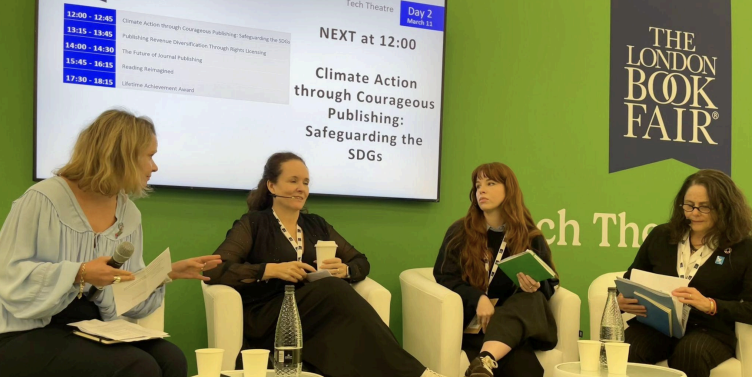
During the second day of the London Book Fair, the IPA’s Copyright and Freedom to Publish Committees held private meetings.
Focusing on the responsibility of the publishing industry to advance the Sustainable Development Goals (SDGs), a panel was held on “Climate Action through Courageous Publishing: Safeguarding the SDGs” at the Tech Theatre. Moderated by Rachel Martin (Senior Global Director Sustainability, Elsevier), the panelists included Mary Glenn (Chief of the United Nations Publications), Lisa Faratro (Director of Environment and Sustainability, CPI Group), and Émilie Hames (Sustainability & Compliance Production Manager, Penguin Random House).
Martin opened the discussions by outlining the scope of SDG 13, Climate Action – a goal that underpins economic stability, food security, inequality, health, and education. For the publishing industry, this SDG has served as both a compass and a common language. When the SDG Publishers Compact launched in 2021 as a voluntary commitment to embed the SDGs across publishing in practice, climate action stood at its centre and was reflected in a wave of net-zero commitments, science-based targets, and responsible production.
Yet, the landscape has shifted. By 2026, climate change no longer commands the top of the global agenda: the public conversation has been moved toward radical technological change and geopolitical shifts. This moment poses a challenge for the publishing industry: “How do we sustain a credible, evidence-based, data-driven approach to climate action? And how do we ensure that the long-term planetary stability isn’t sidelined amongst these AI and geopolitical changes?”
Glenn then offered the UN perspective on the SDGs, drawing out the connection between climate action and human rights. Beyond supply chain sustainability, she argued, the Publishers’ Compact carries a deeper mission: the acquisition of true and verifiable content grounded in climate science. She emphasised that information integrity is foundational to human rights, peace and security, employment, and education.
Continuing the talk, Hames turned to the practical question of how publishers are engaging with this agenda. She noted that progress has been made, but its character has changed: the industry has moved away from public declarations toward a quieter work of embedding sustainability within everyday processes. She stresses that significant effort has been made to gather more robust data on the true impact of operations and production across the supply chain and that it is important to approach shared commitments (e.g., net-zero targets) collectively.
Faratro shed light on the regulatory dimension to the discussion, how the EU Deforestation Regulation prompted publishers to engage more actively and accelerated cross-sector collaboration. She observed that the industry had historically leaned too heavily on private certification schemes such as the Forest Stewardship Council, and that there is now an incentive to build more direct and comprehensive knowledge of suppliers across the supply chain.
The floor was then opened to the audience. Questions touched on the practicalities and limits of replacing paper in publishing, the broadening of risk assessment to encompass human rights alongside deforestation, and how publishers can access dedicated guidance and toolkits. Read more here. The role of children’s publishing also drew attention: the SDG Book Club has set in motion a circle, attracting more publishers to produce climate-related titles for young readers. Books are instruments of change, and when it begins in childhood, it carries particular power. Read more here.
Moving forward, the Charles Clark Memorial Lecture was the final event held at the Main Stage of the London Book Fair on its second day. The annual Memorial Lecture celebrates and remembers the achievements of Charles Clark, who was a publisher, lawyer, and eminent authority on copyright law. You can read more about the lecture here.
IPA’s second day finished with IPA’s Presidents’ Dinner where Past Presidents of IPA have the opportunity to discuss the changes in the sector and the IPA itself.