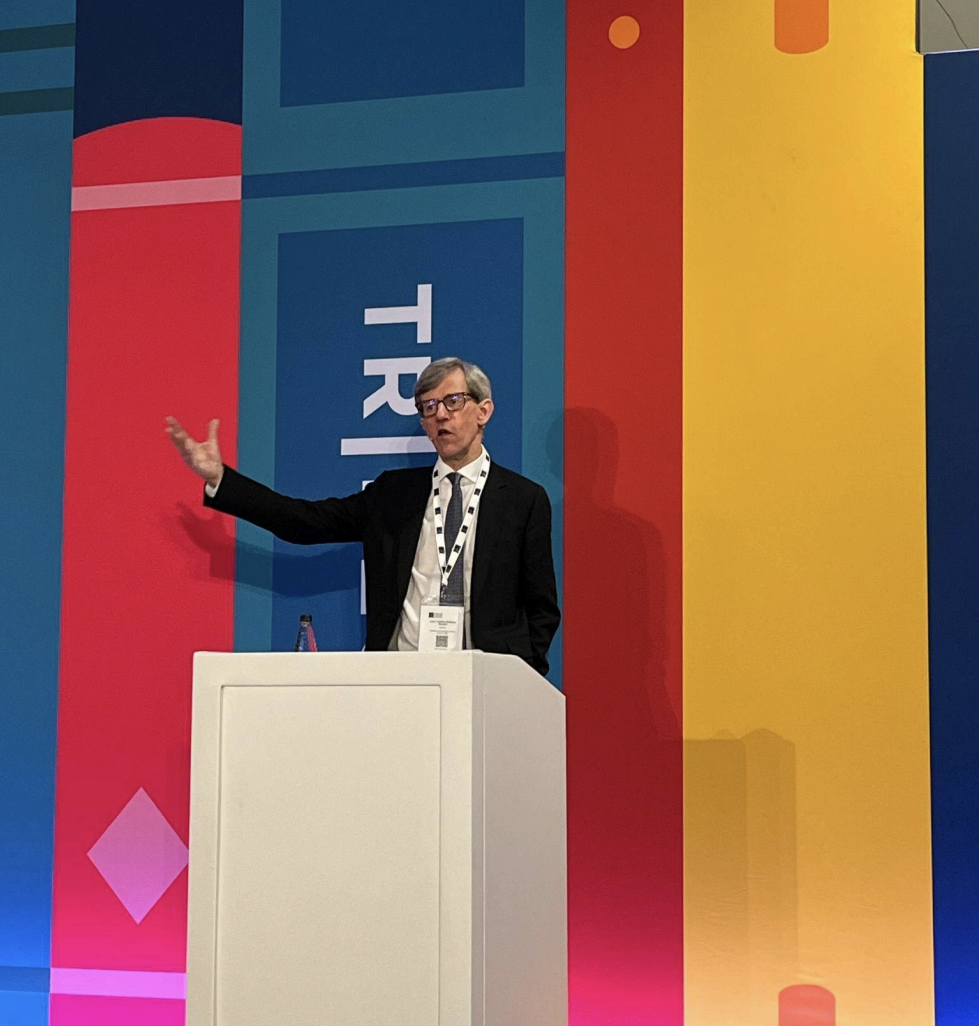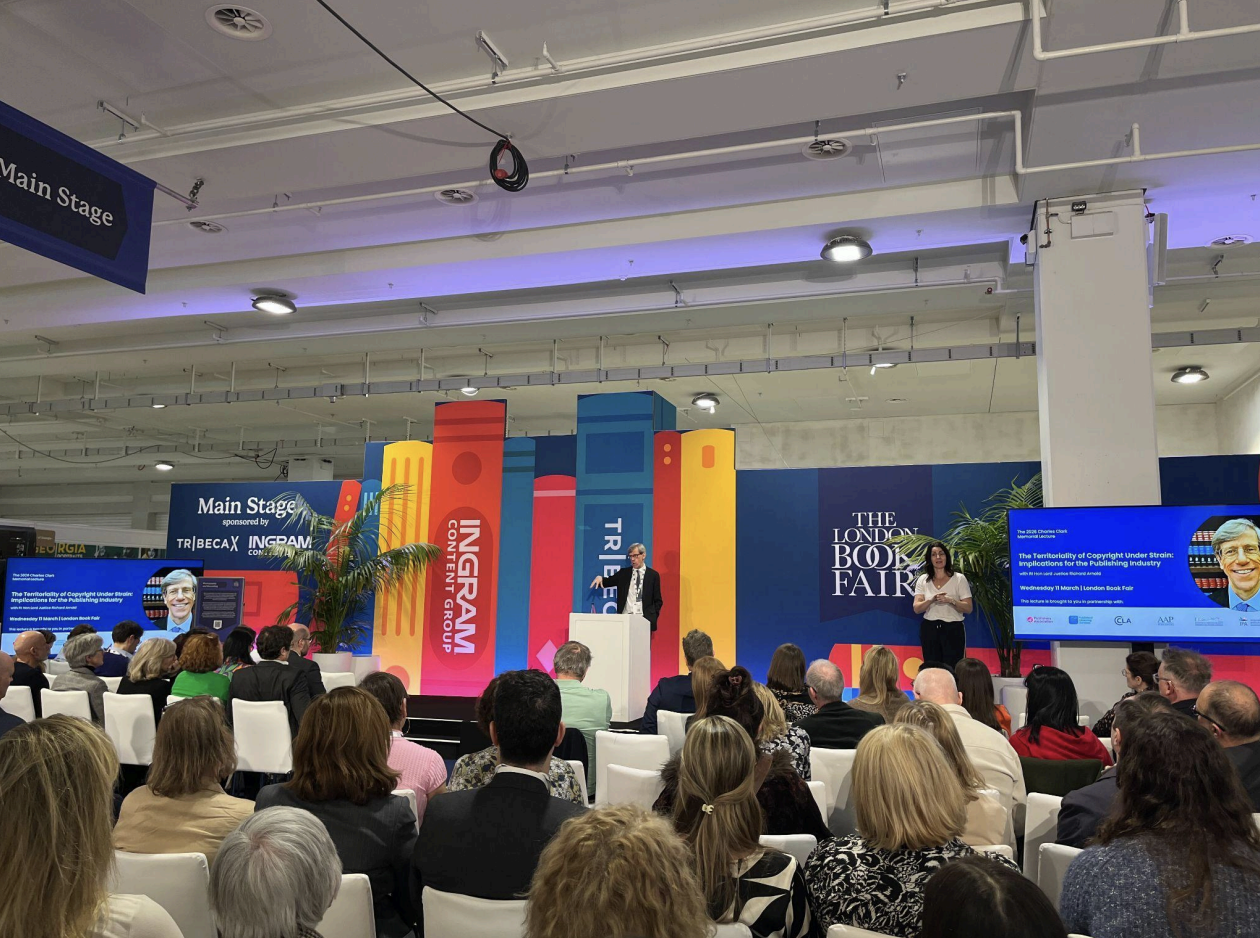
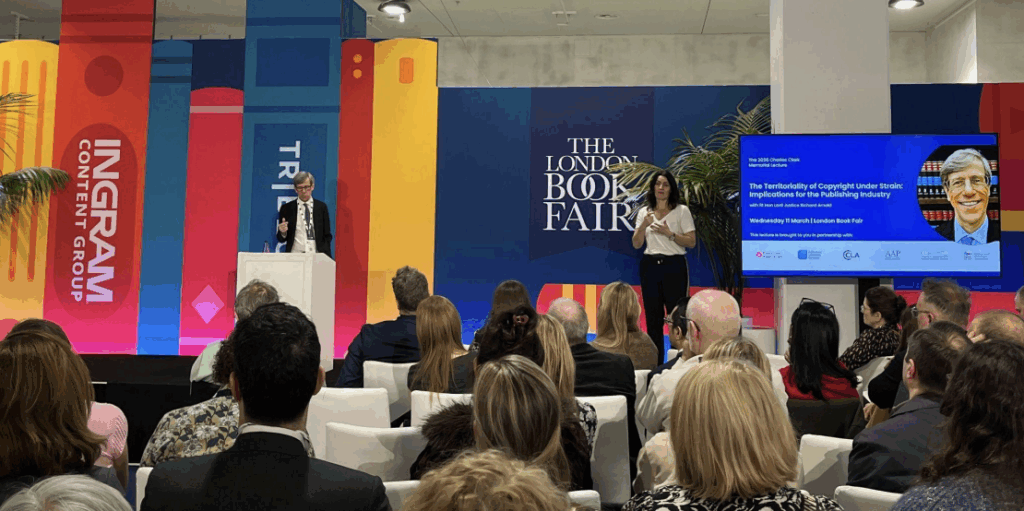
This year’s lecture was given by the Right Honourable Lord Justice Richard Arnold, an eminent judge on matters pertaining to IP Law. Sir Richard delivered a lecture titled “The Territoriality of Copyright under Strain: Implications for the Publishing Industry”, which covered a range of themes, including the structural challenges facing modern publishing from rights exhaustion and the evolving landscape of e-books and e-lendings to the intricacies of collective licensing and AI.
The starting point for the lecture was a question posed by Charles Clark in a paper (“The Answer to the Machine is the Machine”) published during an international conference on the future of copyright in a digital environment in 1995: “Our copyright system, as the central pillar of national treatment in the Berne Convention, is clearly founded on the nation-state. Can publishers maintain the territoriality of copyright in an environment of unstoppable transnational stroke transborder flow of information over the digital highways?”
According to Lord Justice Richard Arnold, this question has become even more pressing as time has worn on. The international copyright system, rooted as it is in the Berne Convention, remains resolutely territorial, which means that each nation-state grants copyrights that are subject to its own laws and which only have effect within the territory of that state. Therefore, the system involves separate national rights which can be separately exploited and require separate enforcement country by country.
He affirmed that this territorial system has been challenged not only by the World Wide Web but also by global platforms and the advent of new technologies such as streaming, virtual private networks, and now generative artificial intelligence. He then moved to the exploration of a few threats that reveal that territoriality is under strain, but nevertheless continues to function.
Exhaustion of Rights
Copyright, like most intellectual property rights, is a limited right. Once a particular copy of a copyrighted work has been sold by or with the consent of the copyright owner, then the distribution right (the right to issue to the public copies of a copyrighted work) is said to be exhausted. This means that a subsequent sale of that copy can infringe the distribution right.
Unlike many areas of international law, the question of exhaustion of rights is not regulated by international law. There are three options to be followed: national exhaustion, asymmetric exhaustion, or international exhaustion. While the US applies international exhaustion, allowing parallel imports, the UK post-Brexit settled on an asymmetric regime, where EEA sales exhaust UK rights, but not vice versa, leaving open the question of whether the UK might one day shift to full international exhaustion.
The speaker stated, “Whether international exhaustion is a good thing or not is controversial. Proponents of international exhaustion argue that it benefits consumers through wider availability and reduced prices of copyright works, arguments that were accepted by the majority of the US Supreme Court. Opponents of international exhaustion argue that it reduces returns to publishers and hence to authors from the exploitation of their works, that it doesn’t really benefit consumers as opposed to old treasures, and that it undermines ecosystems which support the publication of works on niche markets.”
E-Books & Digital Lending
Moving forward, the question “Does the exhaustion doctrine apply to e-books in the same way that it applies to physical books?” was posed.
At the European level, this question was addressed by the Grand Chamber of Justice in the European Union in the Tonkabinet case, which referred to a Dutch company that ran an e-book reading club where members could download second-hand e-books and infringement of copyrights was alleged. The CJEU ruled that e-book downloads fall under the communication to the public right (Article 3 of the Information Society Directive) rather than the distribution right (Article 4 of the Information Society Directive), meaning the exhaustion doctrine does not apply, and copyright owners retain control over e-book dissemination.
Meanwhile, in the US, the case Hachette v. Internet Archive featured that Internet Archive scanned print books and lent digital copies under a “controlled digital lending” model. The platform did not rely on the exhaustion of rights as a defence, but on fair use under the US Copyright Act, which is an inexistent concept in the UK or the EU. The court rejected its fair use defence, and the injunction covered books available in both print and e-book formats. Internet Archive lost on appeal and did not pursue the Supreme Court. Like the Tonkabinet case, the overall effect of this decision reinforced territoriality, but, in the case of acceptance of the fair use defence, the consequences would be felt worldwide, and not merely in the US.
Collective & Extended Licensing
Continuing the discussion, the speaker highlighted the role of collective licensing, which involves a licensing body or a collective management organisation (CMO) granting licenses on behalf of a large number of copyright owners or exclusive licensees to a large number of users.
Extended Collective Licensing (ECL) is a system under which a CMO is authorised to grant licenses on behalf of both member and non-member rightsholders. ECL was introduced in the UK via the 2013 Enterprise Act, a significant expansion of collective licensing reach. In this context, the Secretary of State had a mandate to authorise an ECL scheme, which changed after a decision on a French case, as EU law precluded ECL schemes.
However, in 2024, the UK decided that it no longer considers that the Secretary of State is precluded from issuing ECL, abolishing the supremacy of EU law and, once again, reaffirming the principle of territoriality.
Generative Artificial Intelligence & Copyright
Generative AI (e.g., LLMs, image models) requires vast training datasets, triggering large-scale copyright litigation globally as rights-holders allege copyright infringement on an industrial scale. Lord Justice Richard Arnold presented some of the judicial cases portraying rights-holders and big techs, such as Anthropic (US), Stability AI (England), and GEMA v. OpenAI (Germany). Read more about these cases here.
According to Lord Justice Richard Arnold, the critical but often overlooked question is the following: “Which country’s law is applicable?”, a private international law issue as much as a copyright one. The global nature of AI development means decisions in one jurisdiction have commercial consequences worldwide, regardless of where publishers or rights-holders are based.
The overall conclusion is that territoriality is under strain but still functioning. Whether it continues to serve the publishing industry’s interests as well as it once did is, the speaker suggested, an increasingly open question.
Support
This event was produced in partnership with the Association of American Publishers (AAP), Copyright Licensing Agency (CLA), International Publishers Association (IPA), Federation of European Publishers (FEP), Publishers Association (PA), and Publishers’ Licensing Services (PLS).