
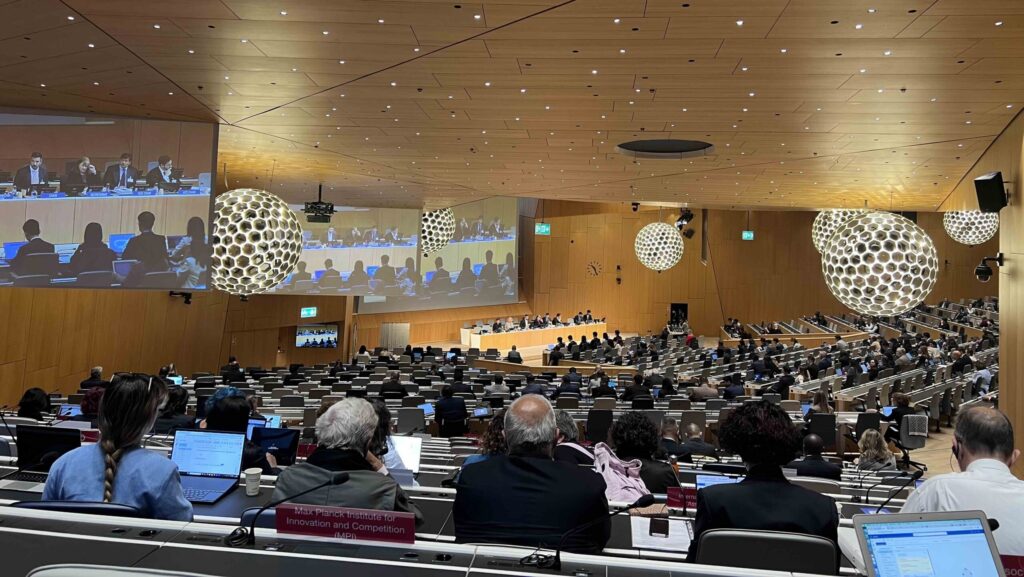
The session was opened by the new Chair, Peter Labody (Hungary) who introduced his new Vice Chairs: Mohamed Mehdi Delmi (Algeria) and Martín Augusto Cortese (Argentina) and acknowledged his long term as Vice Chair ‘I had the privilege to serve you as a Vice Chair for some time now and this has really taught me that the human factor is very important […] this is what truly makes a difference here. As a Chair I will do my best to support you.
He continued, ‘But this is as you all know, a Member State driven process.’ This theme was picked up by Deputy Director General Forbin in her opening remarks, who noted that the agenda for the week could feel ‘overloaded’ but welcomed ‘the diversity of the Delegations and Regions that have put forward various proposals and documents demonstrates the degree of your collective commitment at this Committee.’
Before the agenda was even adopted, Brazil set out its stall, along the same lines as last time: ‘the agenda of the SCCR looks unfit for the current times, to the detriment of WIPO’s credibility as an agency of a UN specialized in innovation and technology for development.’ Brazil asked for a discussion on the Agenda and reorganisation of work of future SCCR sessions under the ‘other matters’ rubric, which is a grab bag of unrelated items.
With that the agenda was adopted, new observers accepted and general statements began. There was much congratulating of the new Chair and Vice Chairs and commitments to constructive engagement. However, WIPO proceedings do not operate in a bubble and the conflicts in Iran and, even more so, Ukraine, were made plain in various Member State positions.
After a short coffee break, the Broadcasting Treaty discussions began with Jukka Liedes taking Member States through the changes to the draft Treaty. The changes were minimal and the Member State interventions that followed suggested that they failed to bring the Committee closer to consensus (or the Diplomatic Conference it would bring). The African Group continued to call for Broadcasting and Exceptions and Limitations to be treated in tandem so they could be finalised together. Across all of the interventions from Member States and observers it remained clear that consensus is some way off.
The first day’s side event, organised by FIAPF, was very well attended and focused on the submerged part of the ‘funding iceberg’ and the risk that producers assume in getting films and series onto screens. Led by FIAPF’s Bertrand Moullier, the session featured Julie Viez (Cinenovo, France), Georges Schoucair (Abbout Productions, Lebanon), Konstantinos Kontovrakis (Kinestet, Greece). All three underlined how intellectual property was fundamental to the way producers gather the funding for movies. Without it, especially for independent producers, very few movies would be made.
Back in the plenary chamber, proceedings continued with a few final interventions from observers on the Broadcasting Treaty before the chair took discussions into informals. As last time, observers can no longer listen in to the discussions. Informals would continue for the rest of the day, leaving the lights low in the plenary chamber as observers drifted out into the Geneva spring. Plenary will continue tomorrow at a time to be determined.
Many of IPA’s delegation will arrive tomorrow ahead of the agenda items on exceptions and limitations and our own side event on Wednesday evening on the importance of copyright for African and Latin American publishers.