
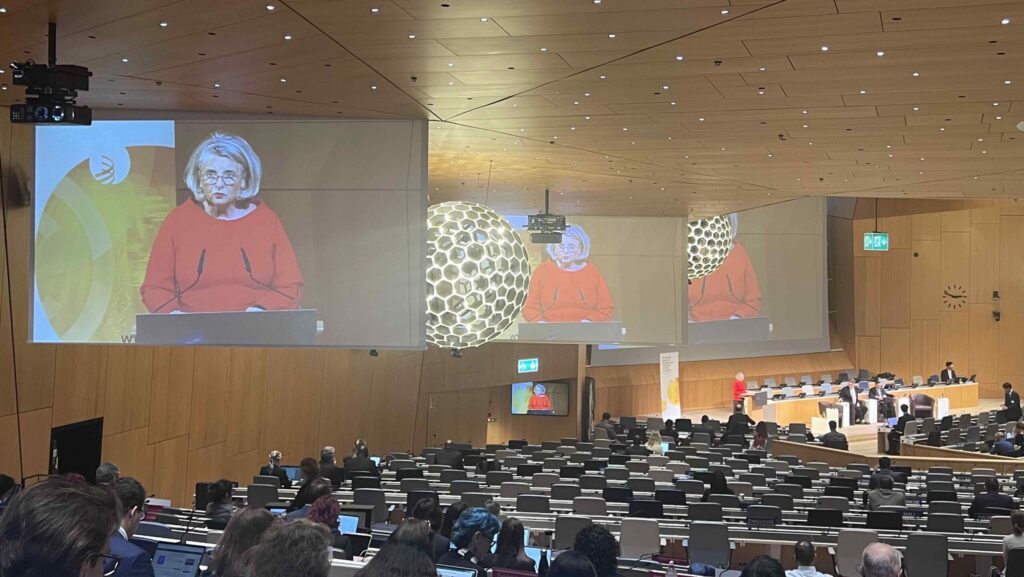
The Chair, Peter Labody, started by reporting back on the informal discussions on the Exceptions and Limitations agenda items which he qualified as ‘constructive’ and ‘fruitful’. WIPO’s legal counsel had joined those ‘rather technical and high level’ discussions, detailing the different types of legal instruments that the Member States can choose to work on.
Finally, Labody was asked to use the African proposal, the US proposal and the previous Chair’s proposal to create a document focusing on preservation, people with other disabilities and on education matters, which can form the basis for exchanges at the next session.
Then the revised schedule began, leading to a few moments of confusion as Member States and observers occasionally spoke to the wrong agenda items. The study on remuneration for audiovisual authors was up first with a presentation and a series of comments. That was followed by a round of comments around a proposal for a similar study on audiovisual performers which has still not achieved consensus. The Artist Resale Right was up next, (keep up!) with Uruguay presenting a regional event it organised on the issue. Member State positions remained consistently divided with some seeking to make this a standing item on the agenda, whileothers resisted, welcoming further presentations of different national systems as a source of information for Member States. Brazil expressed some disatisfaction at the way the regional event was organised without consultation or approval of the SCCR. Noted and item closed. Copyright in the Digital Environment, time is short but let’s get started. Indonesia presented their proposal on the Governance of Copyright Royalties in the Digital Environment, which yielded mixed reactions from Member States. And then Professor Daniel Gervais presented the work done so far on the scoping study on policy or regulatory approaches to the relationship between AI training and copyright, and related rules, and applicable practices on authorization, enforcement and compensation for use. This had been part of the agreements at the last SCCR. Authors have been identified and Gervais hopes to present the study at SCCR 49 in December 2026. Final quick Member State reactions with GRULAC pitching three requests: 1) Member State support for a draft work plan on copyright in the digital environment which they would submit, 2) for the secretariat to prepare a study on the regulatory and legal approach to AI and copyright as well as related rights, and 3) introducing copyright in the digital environment as a standing Committee item on the agenda.
And that brought the morning to a close.
The lunchtime side event was organised by the Access to Knowledge Coalition. It opened with the affirmation that text based discussions on Exceptions and Limitations would begin (is that what Labody meant earlier?). The speakers from Education International, IFLA, Authors Alliance and the Civil Society Coalition then presented various ways in which the current copyright frameworks exposed professionals to legal risk and the choice between breaking the law and restricting research or educational practices. Cross-border challenges, loss of archives to fire, and failure to secure local legislative change were among the issues identified.
The afternoon was an information session on copyright and generative artificial intelligence with 13 invited speakers covering Member State initiatives, an overview of case law, and latest developments in the creative industries over fourhours. The Member State presentations from India, Kazakhstan, Mexico, Saudi Arabia and Vietnam covered a vast range of different local proposals and initiatives, with a wide set of considerations for different aspects of AI creation. Then a second series of presentations consider the blooming number of cases in India, China, the USA and Europe.
And the day closed with different perspectives from publishing, music, visual arts, news media and the audiovisual sector. South African publisher Brian Wafawarowa shared his company’s evolution from an academic, legal and business publisher, to an ed-tech, legal-tech and business-tech company. However, he underlined the risks of the publishing house’s content being made available as training data through an exception and completely undermining its own business proposition. There are already examples of AI-based companies entering the education market and displacing well established publishers.
WIPO Deputy Director General, Sylvie Forbin, closed the day’s proceedings noting that an informed dialogue was necessary: ‘Let’s remain open and ready to identify if and at what juncture cooperation work could prove to be opportune at any given a multilateral level.’
And with that the delegates were released into the fine Geneva evening.